Shipping Is a Profit Lever, Not a Cost Line: How to Start Treating It That Way
Shipping decisions get made in spreadsheets and quietly executed at checkout. A profit-first discount engine brings shipping into the same control surface as the rest of your promotional stack.
If you have been reading this series in order, you have seen a progression: conflict rules, simulation, profit guards, market selection, analytics, custom mechanics, safety rules. Each article has treated a piece of the discount program as a first-class object that deserves explicit design.
Shipping for most Shopify stores does not receive this treatment. It lives as a cost line in a fulfillment spreadsheet. It gets tuned once a quarter. It is discussed when the rate card changes; otherwise, it is treated as a constant. Meanwhile, the shipping decisions threshold, rate, subsidy, and carrier determine the margin of almost every order that goes through your checkout.
This article is the case for treating shipping with the same rigor as every other component of your discount stack.
The default state: shipping by absence of decision
Most stores arrive at their current shipping policy by accumulation rather than design. An initial decision was made early on to use a flat rate, free over some threshold, calculated by the carrier, and it has been left mostly unchanged since. Occasional pushes have adjusted the free-shipping threshold. Occasional experiments have toggled a promotion. The core policy has not been revisited because no one has the capacity to reopen it, and no tool has emerged as an opportunity.
The consequence is a shipping posture that made sense two years ago, in a different cost environment, with a different AOV, against a different carrier contract. Each order under that posture looks fine. In aggregate, it is quietly the largest controllable margin lever in the business.
What shipping optimization actually means
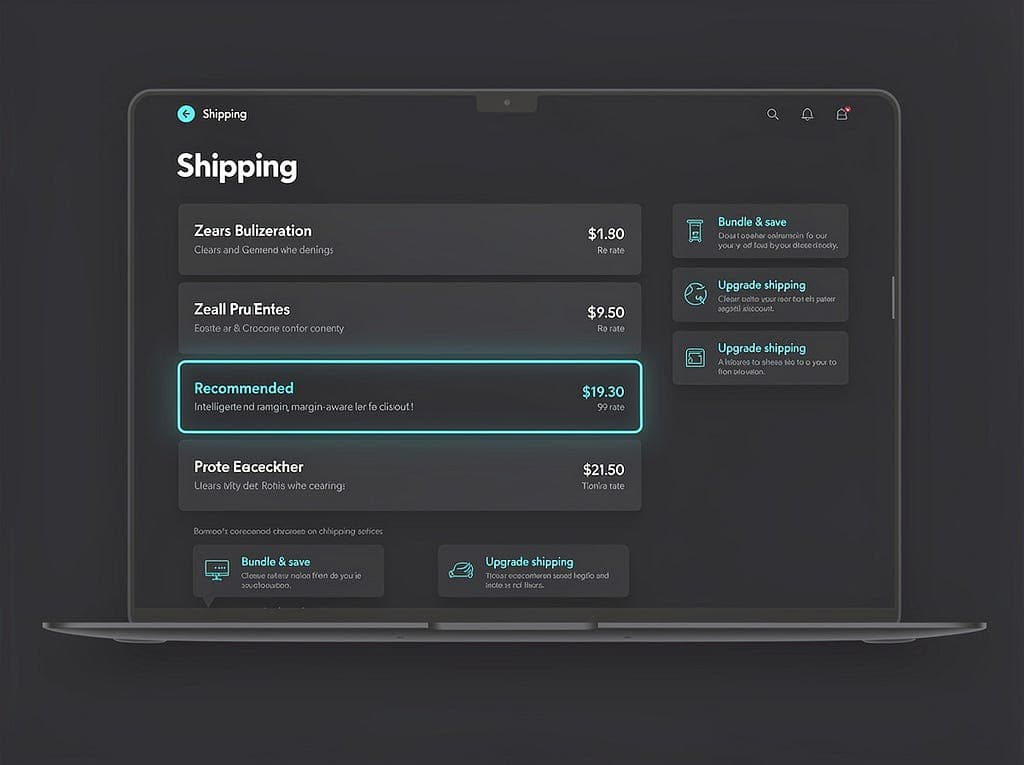
Shipping optimization, inside a modern discount engine, is the capability to treat shipping not as a flat cost but as an outcome of policy that is set centrally, evaluated against the profit rules you have already defined, and executed consistently at checkout across every campaign and every market.
Concretely, that means four things.
First, shipping offers are campaigns. Free shipping above a threshold is a campaign. Flat-rate shipping during a specific window is a campaign. Reduced-rate shipping for members is a campaign. Each one has a scope, a combinability declaration, and a measurable impact on margin. It is not an unstructured setting on the storefront; it is a first-class entity in your promotional calendar.
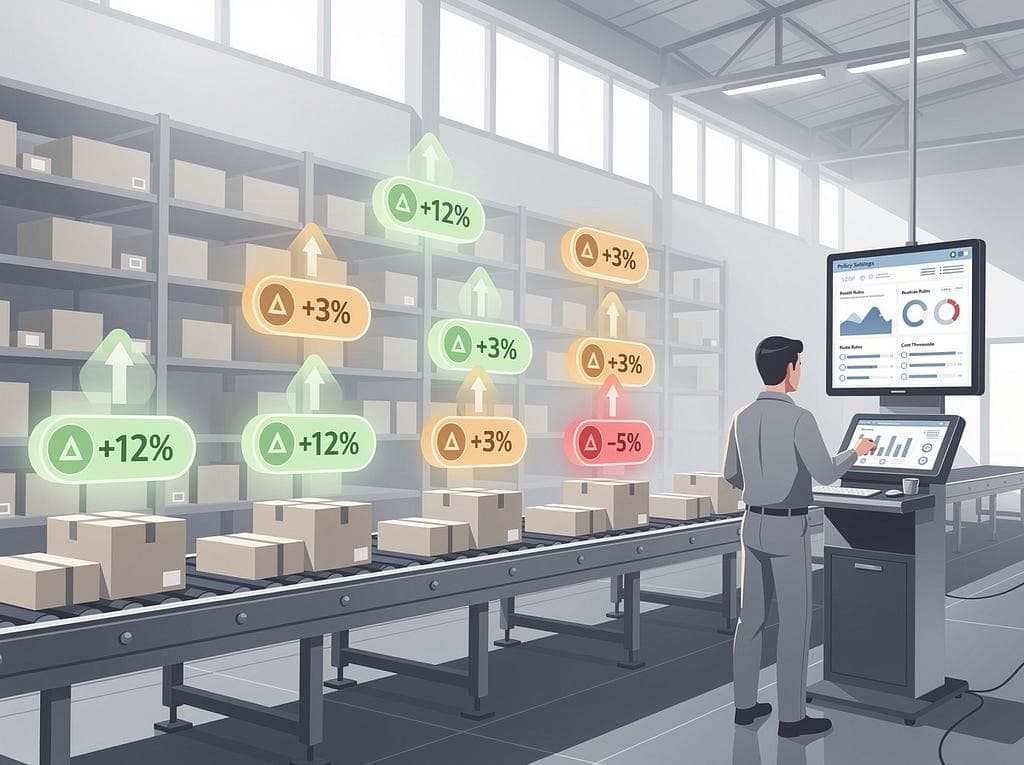
Second, shipping costs are inputs to the profit model. The Profit Guard from Article 3 cannot reason about margin unless it knows the landed shipping cost on the specific order, the destination, the weight, and the carrier. If your shipping costs are locked in a separate system, the guard is flying blind on the single largest variable cost in the order. A profit-first platform brings shipping cost data into the same evaluation surface as product cost.
Third, shipping is scoped by market, as we covered in Article 4, and by customer segment, campaign, and cart composition. The same 'free shipping above $ 75' offer can be active for a loyalty tier and inactive for new customers, active in one market and inactive in another, active on a specific product category and inactive on another. These combinations are not exotic; they are what a sophisticated shipping program looks like. A tool that only lets you toggle 'free shipping threshold' as a single global setting is compressing a two-dimensional problem into a one-dimensional slider.
Fourth, shipping performance is measured with the same attribution rigor we described in Article 5. Every order that benefited from a shipping-related campaign has an attributable shipping subsidy line, visible in the order-level breakdown.
At the end of the month, you can answer the question 'how much margin did our shipping promotions cost, and how much incremental revenue did they bring' without reconstructing the answer from exports.
Where the real profit hides
Most Shopify stores could meaningfully improve contribution margin by doing three things in their shipping program, and each of them requires the program to be structured rather than ad-hoc.
The first is threshold optimization. The free-shipping threshold is not supposed to be a hunch; it is supposed to be the point at which the uplift in crossed carts covers the subsidy on the carts that would have been ordered anyway. That number varies by store; it moves with AOV and drifts with cost inflation. A store that revisits its threshold quarterly, with a simulation of crossed-cart uplift against real history, consistently finds an optimum that is neither where the tool defaults it nor where intuition placed it.
The second is differentiated offers. A single flat rate applied to every market and every cart is rarely optimal. A policy that varies flat in high-density domestic zones, tiered by weight in shipping-heavy categories, and free-over-threshold in specific markets only captures more margin. For most stores, the blocker is not the insight. It is that their tool does not let them express the policy without writing code. A profit-first discount platform removes that blocker.
The third is promotion-aware shipping. When a campaign runs, shipping behavior should respond. During a BOGO campaign, your effective AOV shifts, which means your free-shipping threshold is effectively lower. During a tiered-volume campaign, customers are already being drawn toward larger carts. Your shipping offer can either reinforce that or layer in a way that overpays. A platform that treats shipping as a campaign lets you wire those responses explicitly rather than hoping the interaction comes out right.
Shipping and the rest of the stack
Shipping is the capability that most tightly exercises every earlier piece of this series.
Conflict management (Article 1) matters because shipping offers will routinely touch product discounts, cart discounts, and tier benefits on the same cart. Without explicit combinability rules, shipping interactions produce the bulk of support tickets in many stores.
Simulation (Article 2) matters because threshold tuning without simulation is a guess. The right threshold is the one that, when run against your actual history, produced the best margin outcome, and that's a computation, not a hunch.
Profit Guard (Article 3) matters because a shipping subsidy is often the last layer that tips a cart below margin, and the guard needs to know it's there. Without shipping as an input, the guard makes decisions on incomplete information.
Market selection (Article 4) matters because shipping economics are, for practical purposes, a function of geography. The market layer is where most of the shipping profitability signal actually lives.
Analytics (Article 5) matters because, without attributable shipping subsidies in the order breakdown, you cannot tell which shipping offers paid for themselves. Reporting aggregate shipping costs tells you nothing about the offers.
Custom mechanics (Article 6) and safety rules (Article 7) both apply directly. Shipping is a mechanic class; abuse of shipping (threshold gaming, same-day returns of threshold-qualifying items) is among the most common targets of safety rules.
Put together, this is why shipping optimization, properly defined, is the capability that most stores can improve the most, with the lowest downside risk, once the rest of the discount stack is in place.
What to look for in your tooling
When you evaluate a platform's shipping capabilities, ask three questions. Can shipping offers be declared and managed as campaigns with scoping, combinability, and measurable performance rather than as a single global setting? Are shipping cost inputs integrated into the profit evaluation surface so that the profit guard can reason about the landed margin? And do shipping promotions appear in order-level analytics as attributable contributions, not as a hidden component inside a generic 'shipping' bucket?
Where this leads
For most Shopify stores, the shipping optimization described here is where the series ends - it is the final profit lever, and the rest is execution. But for Shopify Plus merchants, there is one more layer of control available, and it is the subject of the ninth and final article in this series: checkout customization for shipping on Shopify Plus. That's where the control surface we've described extends into the checkout flow itself.
Up next in the series → Checkout Customization for Shopify Plus: extending shipping control directly into the checkout flow.
Part 8 of 9 - The Profit-First Discount Playbook for Shopify Merchants. Each article in the series stands on its own, but is designed to be read in sequence.
Want to put the profit-first playbook into practice?
Discount Prime is where the capabilities of this series conflict management, before/after simulation, Profit Guard, market-level shipping intelligence, order-level attribution, custom mechanics, safety rules, shipping optimization, and Shopify Plus checkout customization come together as one working system. You can install it from the Shopify App Store and start with whichever layer matters most to your business today.
More from the aspedan team → Aspedan blog_
We write about commerce infrastructure, profit-aware tooling, and the ideas behind what we build. If this series resonated with you, the rest of the blog is written in the same spirit for operators who want their promotional calendar to defend margin, not just drive volume._
Related on Discount Prime: Free shipping · Profit analytics