If You Can't Attribute a Discount, You Can't Defend It
Aggregate reporting lies by omission. Order-level discount breakdown is how you finally tell which campaigns paid for themselves.
Everything we've built in the first four articles of this series gives you control. Conflict management lets you decide what applies. Simulation lets you test it. Profit Guard lets you enforce a floor. Market selection lets you scope it by geography.
Control without measurement is blind. This article is about measurement, specifically, the kind of measurement most discount apps structurally cannot give you. This will change every conversation you have about promotional strategy for the rest of your time as an operator.
Most merchants accept the reporting.
Look at a typical Shopify report on promotional performance. You will see the total discount given over a period, the total revenue, and the total orders. You will see how many times a specific discount code was used. You might see a revenue-per-order comparison against a baseline window. You will not see per-order attribution unless you have built custom reporting.
Per-order attribution is the answer to a question that is surprisingly hard to express in most systems: for this specific order, which campaigns contributed what? The welcome discount was five dollars. The tier benefit was three-fifty. The free-shipping subsidy was, effectively, another five. And the cart-level percentage was seven. That order gave away twenty dollars in margin across four distinct mechanisms and earned back forty-two dollars in gross profit. Across the campaign, across the month, which of those four mechanisms was the one that actually paid for itself?
Without a per-order breakdown, you cannot answer that question. You can only observe the aggregate, and aggregates are how unprofitable tactics survive for years.
What dynamic analytics should give you?
A discount engine that treats measurement seriously produces three outputs that most do not.
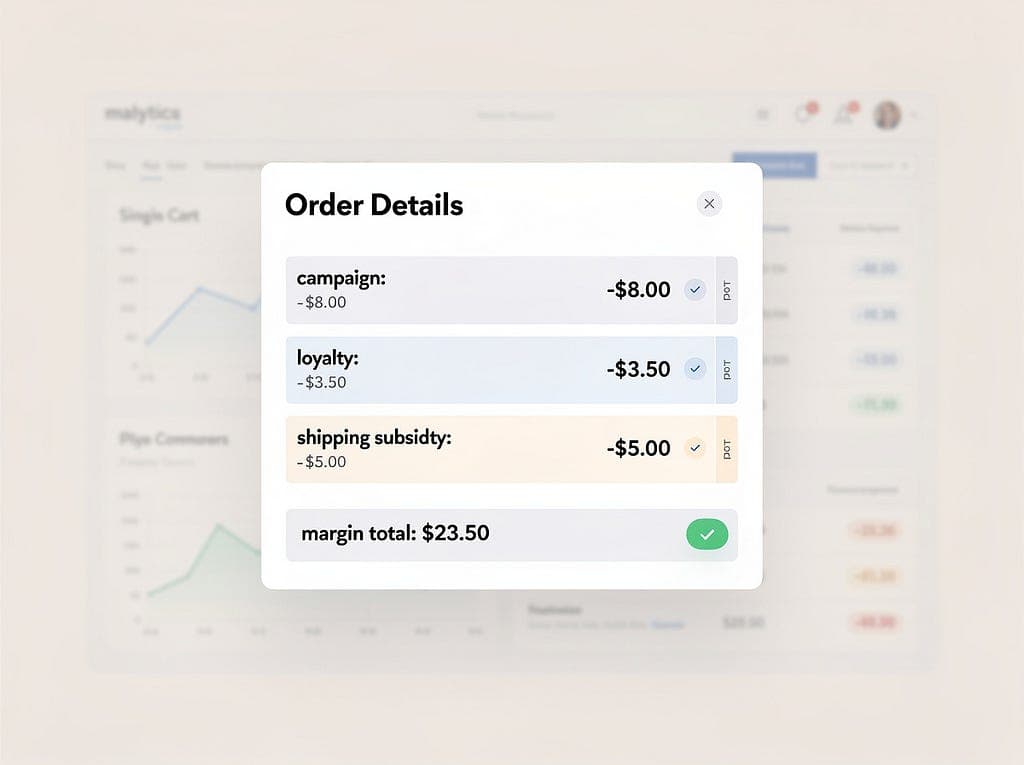
First, every order includes a decomposition of every discount applied to it, at the line-item level where relevant. Not 'discount: $20.' But 'campaign X: -$8.00 on line 1 and line 2; loyalty tier: -$3.50 on subtotal; shipping subsidy: -$5.00; cart-level promotion: -$3.50.' Each of those is attributable back to a specific campaign, with a specific policy, and ultimately to a specific strategic intent.
Second, analytics are dynamic, meaning they can be sliced along any dimension of your campaign structure. By campaign. By combine. By customer segment. By market. By channel. By product. By discount mechanism type. The point is not to produce a fixed report; it is to let you ask the question that matters today, against the data you actually have, with the answer returning in seconds rather than in the two-week round trip of a data team ticket.
Third, tracking is continuous, not a post-mortem. The system tells you, during the life of a campaign, how performance is tracking against the simulation you ran before launch. If the simulation predicted a 12% AOV lift and a 3% margin cost, and the first ten days show a 9% AOV lift and a 4% margin cost, you need to know that now, not at the end of the month when you're choosing the next campaign.
The questions this lets you answer.
With order-level attribution, the conversations that operators have with their data change. A few examples of what becomes possible:
You can tell the difference between campaigns that generated incremental orders and campaigns that subsidized orders that were going to happen anyway. A cohort of orders in which the discount's contribution to cart value was low, say, under 5%, and that occurred in customer segments with strong baseline conversion rates, is probably a segment that did not need the discount. Attribution surfaces this.
You can compare the effective gross margin of every combination you run. Two promotions that stack legally under your conflict rules produce a measurable margin outcome; two that do not produce a different one. At the end of the month, you know which combine earned its keep.
You can identify channels or customer segments where a specific campaign is consistently the highest-contribution discount, and reallocate promotional spend accordingly. If your welcome campaign is carrying your paid-social acquisition cohort and barely touching your organic cohort, that's a strategic input you'd want to be acting on.
You can reconcile promotional P&L with finance. This is the quiet, unglamorous value. When your CFO asks how much margin the month's campaigns cost, and whether that cost was paid back, you can answer with a number that comes from the same ledger as the orders, not from a reconstructed spreadsheet.
The organizational effect of per-order attribution warrants explicit naming. Executive conversations about promotions, at most stores, revolve around a handful of vague claims: 'the campaign drove traffic,' 'the campaign lifted AOV,' 'the campaign brought back churned customers.' Each of these is unfalsifiable without attribution.
With attribution, each claim becomes a testable statement, reported against a clean ledger. Over a few cycles, the team's intuition recalibrates: the campaigns that always got credit but never earned it shrink, and the quiet campaigns that consistently earned margins grow. None of this requires a bigger data team. It requires data that is structured correctly at the source.
Why can't most platforms produce this
Order-level discount attribution requires the discount engine to persist its reasoning, not just its result. When a cart is priced, most systems write the final price. A profit-first system writes the final price and the path - the sequence of rules that produced it, with the contribution of each.
This is an architectural decision made long before the reporting UI is drawn. A tool built solely on Shopify's native discount primitives will struggle because those primitives do not natively preserve the attribution chain in a queryable form. A tool built with profit measurement as a first-class goal produces a structured record of every decision, enabling dynamic analytics downstream.
This is also why, when you see a competitor’s analytics that look thin, the explanation is rarely ‘they didn’t build the UI.’ It’s usually ‘they didn’t capture the data.’
What to look for in your tooling
When evaluating analytics on a discount platform, ignore the dashboards. Look at a single order. Can you see, for that order, the full decomposition of discounts by campaign, in order? Can you export that decomposition? Can you group across orders by any of the dimensions campaign, combine, market, segment, or product, and get a per-campaign margin result? Is the data live or a daily batch?
If the answer to any of those is ‘no,’ the reports you’re being shown are summarizing something you cannot actually drill into. That means your promotional strategy is being tuned on shadows.
Where this leads
Once you can measure what each discount actually did, the natural next question is how the discount is structured. The mechanic matters 'percentage off the cart' is not the same as 'tiered discount on qualifying items', which is not the same as 'fixed dollar off after a condition.' The sixth article in this series looks at custom discount templates and how the ability to choose precisely how a discount works changes which campaigns you can express and which ones move the needle.
Up next in the series → Custom Discount Templates: why 'how this discount works' is as important as 'how much.'
Part 5 of 9 - The Profit-First Discount Playbook for Shopify Merchants. Each article in the series stands on its own, but is designed to be read in sequence.
Want to put the profit-first playbook into practice?
Discount Prime is where the capabilities of this series conflict management, before/after simulation, Profit Guard, market-level shipping intelligence, order-level attribution, custom mechanics, safety rules, shipping optimization, and Shopify Plus checkout customization come together as one working system. You can install it from the Shopify App Store and start with whichever layer matters most to your business today.
More from the aspedan team → Aspedan blog_
We write about commerce infrastructure, profit-aware tooling, and the ideas behind what we build. If this series resonated with you, the rest of the blog is written in the same spirit for operators who want their promotional calendar to defend margin, not just drive volume._
Related on Discount Prime: Profit analytics · Best Shopify discount apps