Shipping at the Highest Resolution: Checkout Customization for Shopify Plus
At the Plus tier, shipping decisions can live inside the checkout itself, the last surface where profit, experience, and policy meet.
This is the ninth and final article in The Profit-First Discount Playbook for Shopify Merchants. We have moved from the foundation conflict rules through the planning, protection, geography, measurement, design, policy, and optimization layers of a modern discount program. Everything in the first eight articles applies to every Shopify store, regardless of plan.
This article is different. It is about a capability that becomes available only on Shopify Plus, and it is the capability that makes the rest of the stack reach all the way to the moment of purchase: checkout customization for shipping.
The plan difference that actually matters
The jump from standard Shopify plans to Shopify Plus unlocks several things: higher throughput limits, dedicated support, and organizational features. Most merchants who move to Plus do it for one or more of those reasons. But the Plus-only capability that most directly affects profit and is most underused is full access to checkout customization, including the shipping step.
On standard Shopify plans, the checkout is powerful but not fully programmable. You configure rates, you ship through carriers, and the checkout presents the rates you configured. The logic ends at the rate card. Plus, the checkout becomes a programmable surface. The rates you present, the order in which they appear, the copy associated with them, and the hidden logic that decides which rate a given customer sees are all addressable.
This is not a cosmetic difference. It is where the profit-first stack from the previous eight articles connects to the customer experience.
What checkout customization unlocks for shipping
Consider the final three decisions any customer faces at checkout: which shipping option they choose, whether to add anything in response to a shipping-related offer, and whether to complete the order. Each of those decisions has a marginal consequence. On standard Shopify, the rates presented are a static list. Plus, with checkout customization, they are the output of a live evaluation.
Concretely, this means:
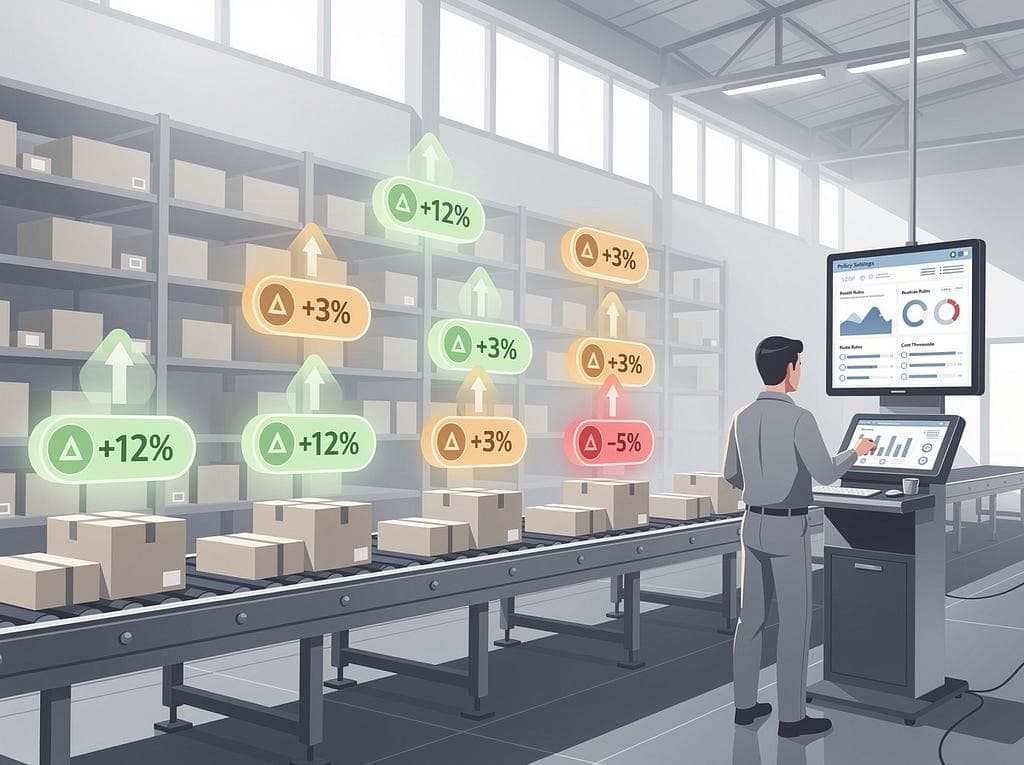
The rate presented may vary by customer. A loyalty tier member sees a different default rate than a new customer. A member approaching their next tier threshold may see a motivational upgrade offer. A customer in a market where you subsidize shipping sees that reflected in the rate list, while a customer in a market you've excluded sees the standard rates.
The rate presented may vary by cart. A cart carrying fragile items defaults to a different carrier service. A cart over a threshold sees free shipping surfaced as the primary rate rather than as a secondary line. A cart that is one unit away from a threshold sees a subtle prompt explaining the benefit of crossing it, not as a pop-up, not as an intrusive upsell, but as information presented at the precise moment the customer is making the decision.
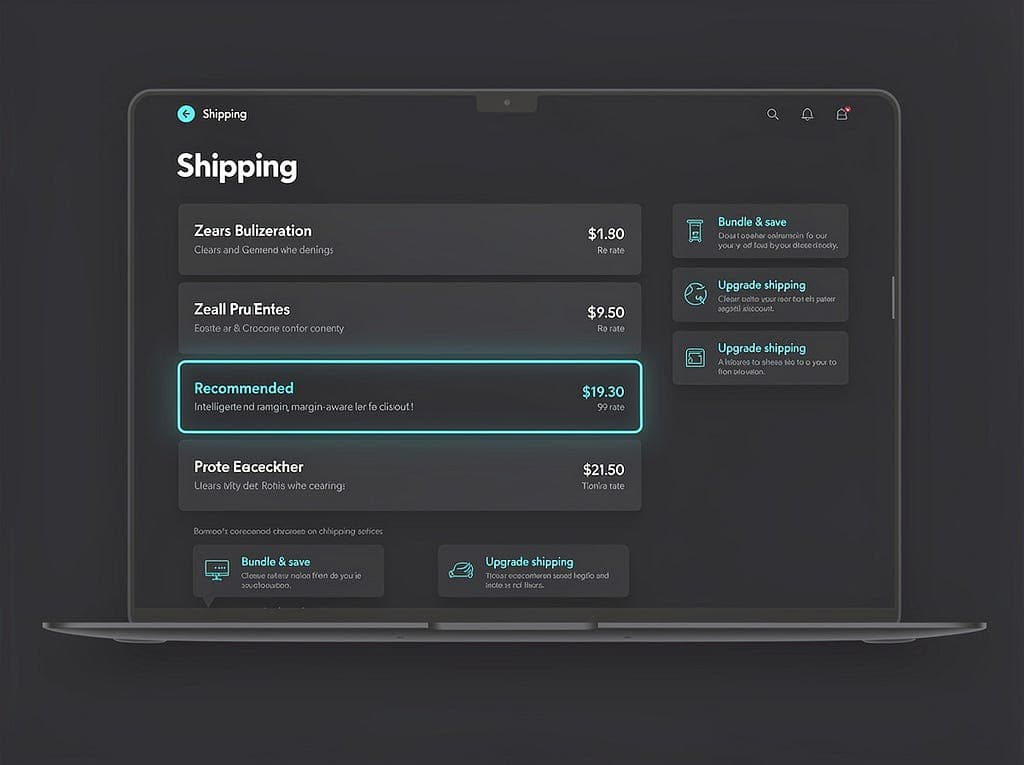
The rate presented can depend on your margin model. This is the most quietly powerful capability. When the profit guard from Article 3 evaluates a cart, it can reason about checkout shipping behavior, and the checkout surface can respond. If a particular rate would push the margin below the floor on this cart, the checkout can either reprice the rate, hide it, or select a different default.
No support ticket. No broken experience. A deterministic, margin-aware rate presentation.
The customer-experience win
It would be reasonable to wonder whether all this logic at checkout risks a worse experience, a checkout that feels too variable, too engineered, too complex. In practice, the opposite is true: complexity at the checkout today is not coming from customization; it is coming from the absence of it.
The confusing checkouts are the ones where five rates appear for a domestic order, two of which look identical, leaving the customer to parse them. The checkouts that feel unfair are the ones where a threshold promotion is running, but the shipping rate doesn't reflect it. The checkouts that feel cluttered are the ones where every customer sees every option, because the system has no capacity to hide what doesn't apply.
A well-customized checkout is simpler from the customer's view, not more complex. Fewer rates. More relevant rates. Clearer framing of the threshold they are near. A checkout that feels like it was designed for them, because to a meaningful extent, it was.
What this does to the stack
Checkout customization on Plus is the last surface on which the profit-first stack operates. Every layer we have discussed conflict, simulation, profit guard, market selection, analytics, custom mechanics, safety rules, and shipping policy culminates here.
The conflict rules in Article 1 ensure that the shipping and product offers produce a coherent final price. The simulation from Article 2 has already told you whether the combined behavior produces a healthy margin. The profit guard from Article 3 watches the live cart. The market rules from Article 4 determine which shipping options are eligible at all. The attribution from Article 5 logs the outcome for analysis. The custom mechanics in Article 6 shaped the offers themselves-the safety rules from Article 7 close off the exploit patterns. The shipping optimization from Article 8 sets the policy. And checkout customization: here is how the customer encounters it as a clean, appropriate, margin-aware shipping experience.
This is the difference between operating a discount program and operating a margin-controlled commerce program. Plus-tier checkout customization completes that transition.
Why most Plus stores underuse this
Having the Plus checkout is not the same as having a Plus checkout strategy. Most Plus stores have the capability and have not built the logic on top of it, for the same structural reason most stores run uncontrolled discount stacks: the tooling they use at the campaign layer does not extend to the checkout layer, so the work has to be done twice, once in the promotional engine and once in a separate customization project.
A platform designed as a full profit-first stack closes this gap. The same rules that govern conflict resolution, profit floors, market scoping, and shipping policy also drive the checkout behavior. There is no separate project. The checkout customization is the execution surface of the rules you have already written, not a parallel codebase.
When that is true, Plus checkout customization stops being a rarely used advanced feature and becomes the natural endpoint of your promotional logic.
What to look for in your tooling
If you are a Plus merchant, three questions matter here. Does your discount platform extend into Shopify Plus checkout customizations natively, or does it stop at the cart?
Can the shipping rate presentation show the rates, the order, and the default, all driven by the same rules that drive your promotional logic? And does the analytics layer from Article 5 surface checkout-level behavior alongside cart-level behavior so that you can reason about the whole funnel?
If the platform stops at the cart, you have the first eight articles of this playbook but not the ninth. For many merchants, that is acceptable. For Plus merchants running meaningful international shipping programs or complex tiered loyalty structures, it is the difference between capturing the available margin and leaving it at checkout.
Closing the series
Nine articles back, this series opened with a claim: most discount apps treat discounts as independent objects, and the consequences of that choice show up in the margin you never measured. Every article since has pointed at one layer of the structural alternative a profit-first discount program, where every promotion is an explicit object with explicit relationships to every other, protected by a live margin floor, scoped intelligently by geography, measured at order-level, expressed through the right mechanic, guarded by coherent safety policy, extended to shipping, and at the Plus tier executed directly in the checkout.
The individual capabilities matter. The compounding matters more. Stores that adopt one of these layers see an improvement. Stores that adopt all of them change how promotions function within the business from a recurring risk to be managed to a controlled lever that reliably adds to contribution margin, campaign after campaign.
That is the playbook. Every feature described in this series exists inside Discount Prime today; the series has treated them as a set of ideas for any merchant building a profit-first discount program, because the ideas are portable. But the compound effect is what we have been building in the product. If any of this has reframed how you're thinking about your own discount program, that is exactly the point of writing it.
End of series → The Profit-First Discount Playbook: nine layers of control, from conflict rules to Plus-tier checkout customization. Thank you for reading.
Part 9 of 9 - The Profit-First Discount Playbook for Shopify Merchants. Each article in the series stands on its own, but is designed to be read in sequence.
Want to put the profit-first playbook into practice?
Discount Prime is where the capabilities of this series conflict management, before/after simulation, Profit Guard, market-level shipping intelligence, order-level attribution, custom mechanics, safety rules, shipping optimization, and Shopify Plus checkout customization come together as one working system. You can install it from the Shopify App Store and start with whichever layer matters most to your business today.
More from the aspedan team → Aspedan blog_
We write about commerce infrastructure, profit-aware tooling, and the ideas behind what we build. If this series resonated with you, the rest of the blog is written in the same spirit for operators who want their promotional calendar to defend margin, not just drive volume._
Related on Discount Prime: Free shipping · Profit analytics