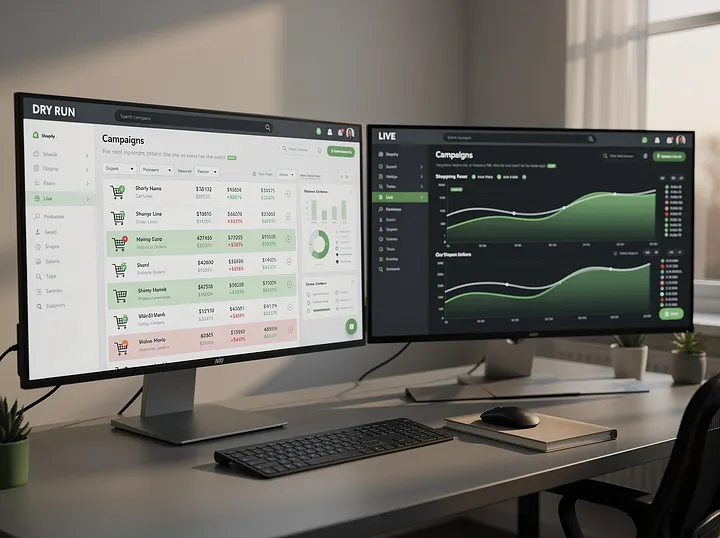
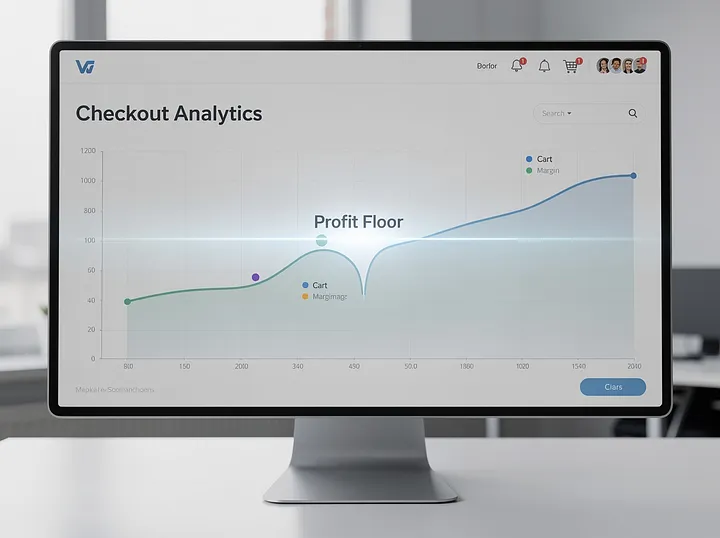
Your best campaign and your worst order can live in the same promotion. A live margin floor prevents bad orders from ever shipping.
So far in this series, we have covered two capabilities that matter before a promotion goes live. Conflict management, which lets you declare how every campaign relates to every other. Simulation, which lets you test those relationships against your actual order history before shipping them. Both are in the planning stage.
But planning has limits. Customer behavior is not fully knowable. Edge cases exist. The specific basket a specific customer builds on a Tuesday afternoon is not in your historical data, and sometimes that basket is the one that breaks your model.
This is where a live margin floor, a Profit Guard, earns its place in the stack. It is the thing that sits at the checkout itself, watching every order as it forms, and enforcing the rule your finance team wishes every merchandiser had written down: no order ships below this margin, no matter what combination of discounts lined up to produce it.
The almost-profitable promotion
Consider a promotion that performs beautifully in simulation. 95% of the orders would have cleared your margin floor with room to spare. The average uplift looks excellent. You ship it. For 99% of actual orders, reality matches the simulation.
Then a customer builds a cart that was never in your history. A mix of promotional SKUs, a product at the end of its price-lifecycle, a shipping destination that costs more than your blended average, and a loyalty tier that your simulation did not fully capture because this customer just crossed the tier threshold yesterday. Everything resolves legally under your conflict rules. Every discount is one you declared. And the final margin on that order is negative.
Without a Profit Guard, that order ships. You find it weeks later, if you find it at all, in analytics. With a Profit Guard, that order either trims the discount back to the floor you defined, or triggers a fallback behavior: suppress a secondary promotion, revert shipping to standard cost, or exclude the line that tipped it. The decision is made at the cart, in real time, based on the specific configuration the customer built.
What Profit Guard actually does
A real profit guard has three properties. It is live: it runs at the moment the cart is priced, not as a post-hoc report. It is per-order: it evaluates the actual cart, not an average. And it is policy-driven: you define what happens when the floor is reached, and the system executes that policy consistently.
That last property is what separates a guard from a warning. A warning tells you something is wrong. A guard intervenes. Depending on your configuration, the intervention can be as gentle as suppressing the lowest-priority discount until the cart clears the floor, or as firm as capping total discount at a fixed percentage of the cart value. The right intervention depends on your brand and your category. The important thing is that the intervention exists and is deterministic.
Why most discount apps cannot do this
Most discount tooling operates on the discount value rather than the order margin. This is a subtle distinction with massive consequences. A tool that only sees discount value can tell you this promotion is 20% off, but it cannot tell you, at the moment of checkout, whether 20% off this specific product to this specific customer in this specific market leaves you with a positive margin. It does not have the cost of goods sold. It does not have the landed shipping cost for that destination. It does not know what the cart actually earns.
A profit-aware guard is structurally different. It is integrated with cost data, either COGS on the product, blended cost ratios at the category level, or dynamic landed-cost models that include fulfillment and payment processing. It is priced in real margin, not an apparent discount. That is what allows it to make useful decisions at the cart.
The campaigns you can run once you have a floor
The practical effect of a Profit Guard is not that you run smaller promotions. It is that you run larger ones, more confidently.
The storewide 25% campaign that you held back to 15% because you were worried about the tail of deeply stacked orders is now safe to run at 25%, because you know the tail is clipped at your floor. The BOGO-plus-free-shipping combination that you excluded as too risky is now expressible, because the guard will trim it on the specific orders where it would otherwise break margin. The aggressive loyalty tier you wanted to offer your top 5% of customers, but could not justify, you can offer it, because the math on any individual cart is held within a safe band, regardless of what else happens to be running.
The goal here is not to maximize generosity. It is to remove the self-imposed ceiling on promotional depth that exists only because you cannot trust the tail of the distribution. A guard lets you trust the tail.
There is a second effect, quieter but just as important: the internal conversation about promotions changes. Merchandising, marketing, and finance are no longer negotiating against a single depth number that each team interprets differently. They agree on a floor below which no orders ship, and then design campaigns above it. Merchandising gets to propose the depth they believe will move product; finance gets an enforced guarantee that individual orders will not break the margin model; marketing gets the freedom to run richer offers.
Combined with simulation, this is decisive
The combination of simulation and profit guard is the point at which discount management becomes a true margin-protected system. Simulation tells you what a campaign would have done to the orders you already know about. The profit guard handles orders you may not yet know about. Together, they give you a two-layer defense: the top layer catches systemic risk before launch, the bottom layer catches tail risk at the cart.
Most stores have neither layer. They run promotions, they watch aggregate numbers, and they absorb the tail as a cost of doing business. In a low-growth environment, or a category with thin margins, that absorbed tail is often the difference between a profitable year and a flat one.
What to look for in your tooling
When evaluating a platform for live margin control, three questions matter. Is the guard priced in real margin, meaning it integrates with cost data and evaluates the cart's actual profitability, or is it a simplified cap on the discount percentage? Is the intervention policy configurable, so you decide what happens when the floor is reached? And is it deterministic, so two identical carts always resolve the same way?
A discount percentage cap is not a profit guard. A profit guard is a guard on profit. You can see the same idea applied across campaigns in profit analytics, where net margin is calculated per campaign and per order from your real Shopify cost prices.
Where this leads
Profit Guard protects you on any cart, anywhere. But some of your margin problems are not about the cart; they are about the shipping destination itself. Some markets are unprofitable to ship to, no matter how well your promotions resolve, and most discount tools have no concept of this. In the next article, we look at market selection and the automatic exclusion of unprofitable shipping markets, the fourth piece of the profit-first playbook.
Part 3 of 9 - The Profit-First Discount Playbook for Shopify Merchants. Each article in the series stands on its own, but is designed to be read in sequence.
Want to put the profit-first playbook into practice?
Discount Prime enforces a margin floor at checkout and brings profit analytics and conflict-safe campaigns together as one Shopify-native system, so you can run aggressive offers without selling below cost.
Related on Discount Prime: Profit analytics · Best Shopify discount apps