
Eight apps, dozens of features, one recurring blind spot: no one is optimizing on the signal that matters most.
This is a companion piece to the Agentic Commerce Playbook for Shopify Merchants. Over the last two quarters, I've done detailed evaluations of eight of the most-installed discount apps on the Shopify App Store. The goal was not a 'best of' list. It was a structural look at what the category collectively does well and where it fails. This piece summarizes the analysis's findings.
I will not name apps individually from my own scoring because the specific strengths and weaknesses shift too quickly to keep a published ranking accurate. The pattern across them is more durable, and it is the pattern that matters for a merchant choosing tooling or a founder benchmarking their own app. For readers who want named apps, I cite a public side-by-side comparison further down.
How the eight were evaluated
For each app, I evaluated coverage in five areas: campaign breadth (how many promotion types it supports), targeting precision (customer segments, geo, channel), reporting quality (what numbers it actually gives you), stacking and combining logic, and AI or agentic readiness. Then I scored each app on whether its reporting surfaced margin, not just GMV; whether it exposed campaigns to agent channels; and whether it could reason about stacking intelligently or just allowed it.
What emerged was not a simple 'app X is best' conclusion. It was a distribution of strengths across apps, with a striking amount of shared territory and a small set of capabilities that almost none of them had.
Where coverage is identical
All eight apps do flat discounts, tiered quantity discounts, and BOGO. Seven of the eight do cart-level spend thresholds. Six do some variant of BXGY. Five do shipping-based campaigns in at least a basic form. The commodified core of the category (the features every merchant first thinks of when they say 'discount app') is genuinely saturated. Choosing among apps on these features alone is nearly arbitrary.
This matters because it resets the evaluation question. The features most merchants compare are not differentiators. If you are evaluating based on 'does it do tiered quantity', you will find that yes, they all do. The question is what else?
The four capabilities almost no one has
Four capabilities show up rarely across the eight, and they are the ones that will matter most over the next eighteen months.
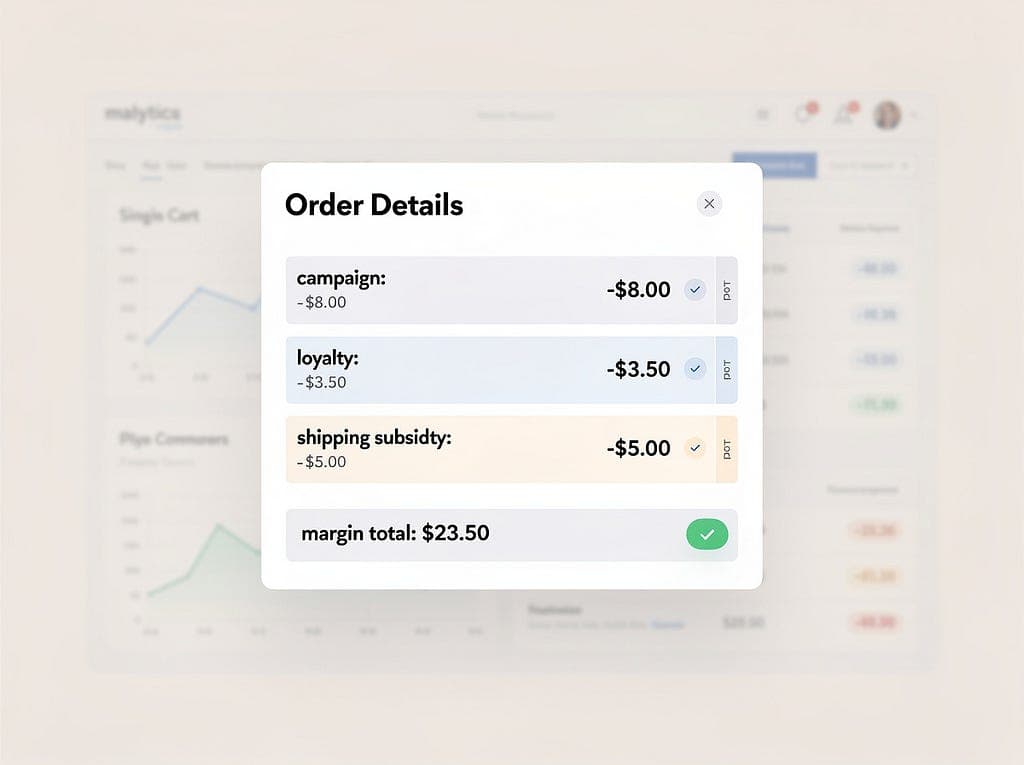
The first is margin reporting with cost-price data; two of the eight surface it. Six do not. They report GMV lift and discount amount issued, full stop. A merchant using any of the six will struggle to answer the basic question of whether their campaign made money.
The second is agent-channel exposure. Three of the eight have shipped some form of MCP endpoint or agentic product feed integration in the last two quarters. Five have not. As agent-originated traffic grows, the first group will capture attributable orders; the second group will watch unexplained demand drift away.
The third is stacking intelligence. All eight apps allow stacking to some degree because Shopify's platform now enables it. Only two apps actively reason about which stacks maximize margin and which cause margin breaches. The other six surface a configuration page and leave the optimization to the merchant's instinct.
The fourth is cross-channel coherence. Seven of the eight treat campaigns as storefront-primary, with POS and agent channels as afterthoughts. One explicitly models the multi-channel promotion state and resolves conflicts across them. That one has a capability that is nearly impossible to retrofit into the other seven.
Where the all-in-one suites fit
Some merchants sidestep the standalone-app comparison entirely and go all-in-one. Vitals, for example, bundles volume discounts, quantity breaks, and tiered pricing with 40+ other conversion tools in a single subscription, which solves a different problem: app-stack sprawl and the performance cost of multiple scripts. Judged against the four capabilities in this analysis, the all-in-one approach buys breadth rather than margin intelligence, so the right choice depends on whether your bottleneck is tooling consolidation or profit visibility.
Why the gap exists and why it persists
The gap is structural. The basic discount capabilities are what merchants asked for first, and they are what every app had to ship to be viable. Margin reporting requires cost data that the platform does not surface. Agentic readiness requires protocol work that became relevant only recently. Stacking intelligence requires optimization models. Cross-channel coherence requires a data layer that most apps did not build.
Each of the four missing capabilities represents engineering and product investment that had no commercial return until the last twelve months. Apps that invested early are now in a strong position. Apps that did not are now trying to catch up against a moving target. The gap will not close uniformly. It will widen.
What merchants should ask vendors before signing a renewal
If you are a merchant at renewal, four questions put the vendor on an honest footing.
Does your reporting surface margin, using the cost-price data I provide?
Does your app expose active campaigns to agent channels through MCP or an equivalent mechanism?
Does your stacking logic actively optimize for margin, or does it simply allow stacking?
And does your data model treat my POS, web, and agent channels as a single coherent surface, or as three separate ones?
If the vendor answers yes to all four credibly, they are in the top quartile of the category as of mid-2026. If they answer yes to two, they are median. If fewer, they are below. None of this makes them bad tools. It means you know where the gaps are, and you can plan accordingly, either by investing in complementary tooling or by preparing to switch when the gaps start to bite.
A direct look at a few named apps

The analysis above keeps my own scoring anonymous, but a public side-by-side is useful for putting names to the pattern. A fair comparison of six Shopify B2B and wholesale apps (TradeQuote AI) scores them on seven capabilities: tiered pricing with min/max per tier, B2B accounts with approval and MOQ controls, bulk catalog repricing in one action, conflict-safe B2B plus DTC on a single install, net margin analytics per campaign, bulk discount-code generation, and metafield-based campaign targeting. Where each app lands maps cleanly onto the four gaps above.
Discount Prime is the one app built campaign-first. It reports net margin per campaign and per order from real Shopify costs, supports metafield targeting, and generates up to 1,000 unique discount codes per campaign. Its main limitation is that it is a newer entrant still building brand recognition.
BSS B2B offers a full B2B stack (custom signup, approval, MOQ rules, and segmented wholesale pricing in one app), with strong segmentation, but it does not report campaign-level margin.
Wholesale Pricing Discount B2B maps tags directly to discounts with fast CSV setup, but it has a limited campaign structure and no margin analytics or metafield targeting.
B2B Wholesale Hub bundles net terms (Net 15/30), quick order forms, and tag-driven pricing, without campaign analytics, margin tracking, or metafield targeting.
Bold Custom Pricing combines wholesale, VIP, and member pricing inside the mature Bold ecosystem, but lacks campaign margin analytics and bulk code generation at scale.
SparkLayer is an enterprise-grade B2B layer with a self-serve portal, account hierarchies, and sales-rep tools, priced at a premium and built around account-driven pricing rather than campaign or metafield logic.
The comparison's own conclusion is that there is no single winner: account-management tools and tag-based systems each cover part of the surface, while margin analytics and metafield-driven campaigns remain rare. That is the same blind spot the eight-app analysis surfaced, now with names attached. Full criteria and the per-app breakdown are at the Shopify B2B and wholesale apps comparison.
The takeaway
This is not a 'best of' listicle. It is a structural read of what the top eight discount apps do well and where they collectively fail. The payoff is a framework merchants can apply even to apps that aren't on the list: does your app see margin, does it see agents, does it see stacking, does it see the difference between a cart and a customer?