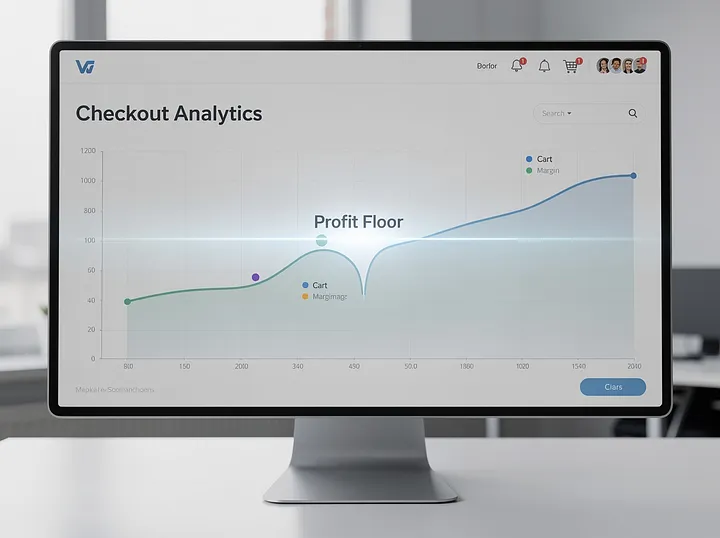

The biggest discount and the most profitable promotion are rarely the same thing. A profit-first promotion starts from the margin you intend to keep and works backward to the discount you can actually afford.
Why most discounts quietly lose money
Most merchants run promotions the same way: pick a percentage, apply it across the store, and hope volume makes up the difference. The trouble is that a flat number lands very differently across a catalog. A flat 20 percent off can erase the entire margin on a low-markup product while barely denting a high-markup one. You end up subsidizing your worst-margin SKUs the hardest, which is the opposite of what you want.
The result is the pattern we wrote about in why GMV is a vanity metric: revenue goes up, the dashboard looks green, and the quarter still comes in soft because nobody measured what the campaign did to contribution margin.
Profit-first promotions flip the model. Instead of starting from how big a discount you can advertise, you start from how much margin you need to keep, and let that decide the discount.
The three levers that decide whether a promotion makes money
Almost every promotional outcome comes down to three variables. Get these right and the rest is detail.
Margin floor. The minimum profit you are willing to accept on any order. This is the single most important number in a promotion, because it is the line a discount must never cross. Without it, a deep enough discount, or two discounts stacking, can sell a product below cost without anyone noticing until the numbers come in.
Average order value. A discount that drives more units per order can be profitable even at a lower per-unit margin, because the larger basket carries the campaign. This is why volume and tiered offers usually beat flat sitewide percentages: they reward the behavior, bigger orders, that actually protects your economics.
Discount conflicts. This is the silent killer. An automatic campaign and a code-based discount can stack on the same order and double your giveaway. Most stores discover this only when they audit a strange-looking order. Conflict control is not a nice-to-have; it is the difference between a planned promotion and an accidental one.
A simple framework you can run every time
- Calculate true margin per product, including cost of goods and platform and payment fees, not just the headline markup. You cannot protect a number you have not measured.
- Set a margin floor you never cross. Decide the minimum profit per order and make it a hard rule, not a guideline.
- Prefer volume and tiered discounts over flat sitewide percentages, so the discount scales with order size instead of eroding every sale equally.
- Target by margin, not just by collection. Discount the products that can carry it, and protect the ones that cannot.
- Turn on conflict detection so two promotions never stack unintentionally and quietly push an order under your floor.
The goal is not the biggest discount. It is the most profitable conversion.
What profit-first thinking looks like in practice
A flat 25 percent sitewide sale is the blunt instrument. A profit-first version of the same goal might be 10 percent off at three units, 15 percent at five, with a hard margin floor so no combination ever sells below cost, scoped to the collections whose margins can absorb it. The advertised "save up to 15 percent" still pulls shoppers in, but the structure protects the downside and rewards larger orders.
The shift is not about discounting less. It is about discounting on purpose, where the math works, instead of everywhere at once.
Where Discount Prime fits
This is exactly the layer Discount Prime is built for. It runs ten discount types, from volume and tiered unit pricing to Buy X Get Y and free shipping, in one Shopify-native app, so you can choose the mechanic that fits the margin instead of defaulting to a flat percentage. It surfaces real-time margin analytics on every campaign, so you can see the profit impact before a promotion goes live rather than after the quarter closes. And it includes conflict detection that automatically flags when two campaigns would stack, so the most common way promotions lose money never happens by accident.
In other words, the framework above stops being a spreadsheet exercise and becomes something you configure once and trust. The margin floor, the targeting, the conflict rules, and the reporting all live in the same place the discount runs.
Bringing it together
Profitable promotions are not the ones with the loudest discount. They are the ones built backward from the margin you decided to keep, structured to reward bigger orders, and protected from stacking into a loss. Decide your floor, prefer structure over flat percentages, measure margin per order rather than revenue, and let the tooling enforce the rules so a good promotion cannot quietly become a bad one.
Discount Prime brings ten discount types, real-time margin analytics, and conflict detection into one Shopify-native app.
Related on Discount Prime: Profit analytics · Volume discounts · Wholesale pricing