The hardest part of a holiday sale is not starting it. It is ending it without watching your traffic go cold the moment the banner comes down.
Most Shopify stores plan the entrance to a holiday sale in detail and give no thought to the exit. Then December 26 arrives, the sitewide code switches off, full price returns overnight, and the same traffic that was converting all month suddenly bounces. If you sell to consumers, the days after Christmas are some of the highest-intent, highest-refund, lowest-loyalty days of your year. How you leave the sale decides whether that intent carries into January or evaporates.
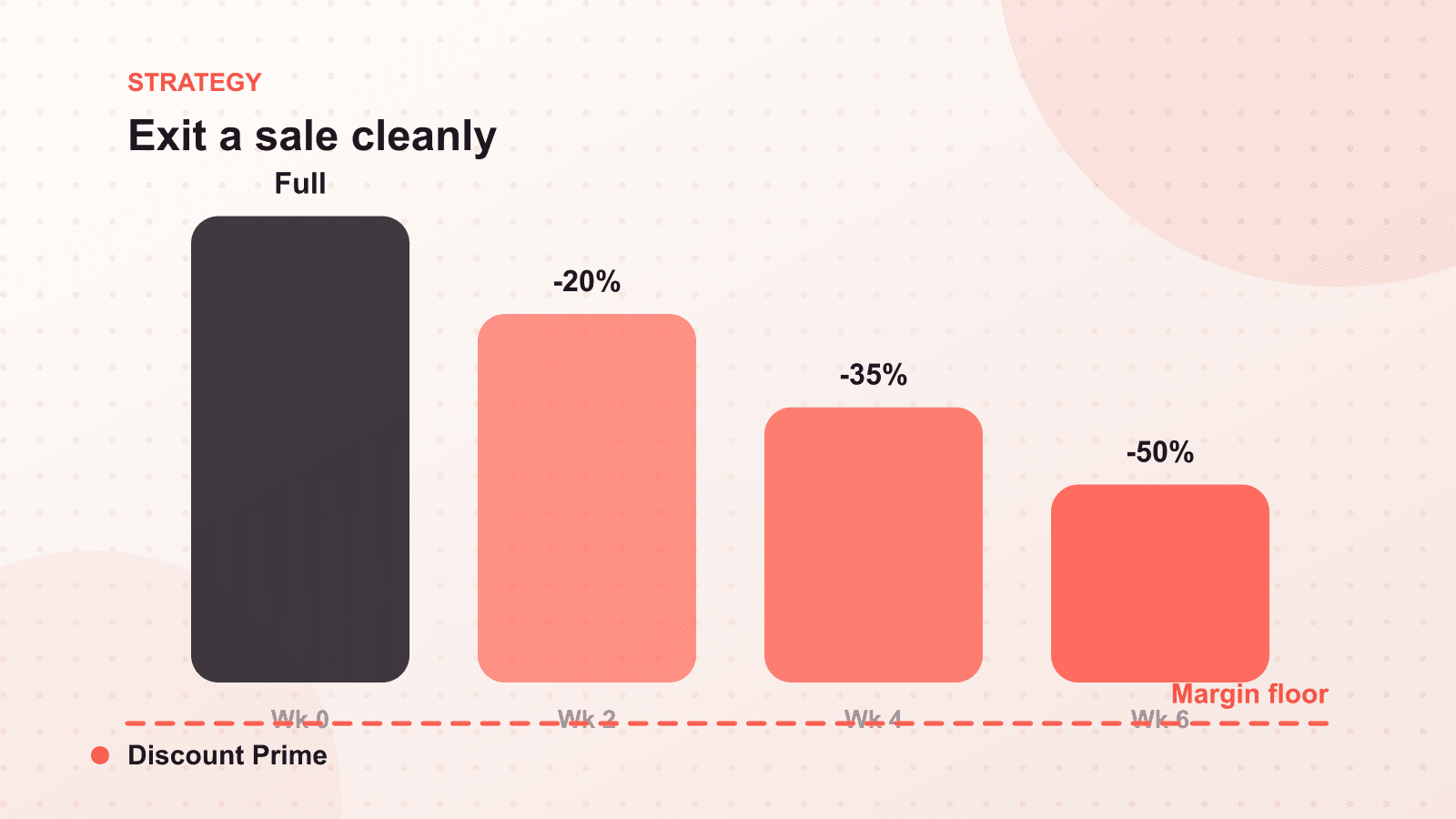
The short answer: ramp the discount down in stages instead of flipping a switch, replace "everything is on sale" with a narrower reason to buy, and pivot toward the buyers who actually restock in January. A cold-turkey return to list price on the 26th is the most reliable way to train customers that your store is only worth visiting when it is bleeding margin.
Why the day after a sale is so dangerous
During a sale, your conversion rate is propped up by a discount that touches every order, including the ones that would have happened anyway. When you remove it in one step, you do not return to your baseline conversion rate. You often dip below it, because the shoppers who arrived expecting a deal now feel they missed it.
This is the anchoring problem in reverse. For three or four weeks you taught the market that your prices carry a discount. Undo that in a single day and full price reads as a price increase, even though it is just your normal price. The fix is not to keep discounting forever. It is to let the anchor fade instead of snapping.
Ramp down in stages, do not flip a switch
A staged exit shrinks two things at once: how deep the discount is, and how many products or customers it applies to. Each step gives returning visitors a smaller but still real reason to act, and each step lets your average margin recover before the next one.
Here is a sample three-week ramp for a store that ran 25% off sitewide through Christmas:
| Window | Offer | Scope | Depth |
|---|---|---|---|
| Dec 26 to Dec 31 | Year-end clearance | End-of-season collections only | Up to 30% |
| Jan 1 to Jan 7 | New Year refresh | Selected collections | 15% |
| Jan 8 to Jan 14 | Bundle and volume offers | Bestsellers | Effective 10% via tiers |
| Jan 15 onward | Full price plus segment deals | Wholesale and VIP only | Varies by segment |
Notice the depth does not fall in a straight line. Clearance can go deeper than the sitewide sale did, because it is aimed only at inventory you want gone. The general shopper sees the headline discount shrink week over week, which nudges the undecided to buy sooner rather than wait for a better deal that is visibly disappearing.
Replace "everything is on sale" with a reason
A sitewide percentage is a blunt instrument that says nothing. A reason-based offer says something specific and holds its value: "end-of-season clearance," "New Year bundle," "restock pricing for trade accounts." Reasons let you keep an offer live without eroding your list price, because the customer understands the discount is tied to a condition, not to your product being worth less.
The mechanical version of this is tiered pricing. Instead of 15% off one shirt, a customer who buys three gets a per-unit break. The discount now rewards a behavior you want rather than subsidizing a purchase that was already going to happen. Structuring these tiers well is its own craft, and getting the anchor right matters more than the depth. You can go deeper on that in our guide to tiered pricing on Shopify, and on protecting the numbers underneath in how to protect margin during sitewide sales.
The January B2B pivot most stores miss
Consumer demand cools in the first weeks of January. Wholesale demand does the opposite. Trade buyers, resellers, and repeat business accounts spend late December selling through their own holiday stock, and early January restocking it. If your store serves any B2B or wholesale buyers, January is when they come back to the well.
This is the cleanest place to keep revenue warm without discounting to the public. A tag-based B2B pricing rule lets you show restock terms only to accounts you have marked as wholesale, while every other visitor sees your recovered full price. The consumer side of your store exits the sale; the trade side gets a reason to reorder. We go deeper on that seasonal pattern in January is for B2B: why wholesale buyers restock.
A worked example
Say your average order is $60 at a 40% gross margin, or $24 of margin per order. A 25% sitewide discount during the holidays cuts that to roughly $9 of margin per order, and you accept it for volume. If you hold that 25% into January out of fear of losing traffic, you are giving away $15 of margin on every order at exactly the point where order volume is falling anyway. That is the worst possible trade.
Now run the staged ramp instead. By the second week you are at an effective 10% through bundle tiers, which restores you to roughly $18 of margin per order, and the discount only pays out when a customer buys more. By week three the general shopper is at full price and your remaining discount is a targeted wholesale offer that you priced deliberately. Same calendar, very different January.
What to watch as you exit
Track three things through the ramp. Watch margin per order recover week over week; if it is not climbing, your stages are too shallow. Watch conversion rate on returning visitors; a small dip is normal, a cliff means you removed the reason to buy too fast. And watch repeat and wholesale order share rise as consumer orders fall, which tells you the January pivot is working. Our analytics can show you which of these offers is actually carrying revenue rather than just moving volume.
Setting this up with Discount Prime
Discount Prime lets you schedule each stage of the ramp in advance, so the clearance, the bundle tiers, and the January wholesale offer all switch over on their own dates without a scramble. You can run tiered pricing for the consumer ramp and tag-based B2B pricing for the restock buyers at the same time, on any Shopify plan. Plan the exit now, before the 26th, and January takes care of itself. You can find the app on the Shopify App Store.