
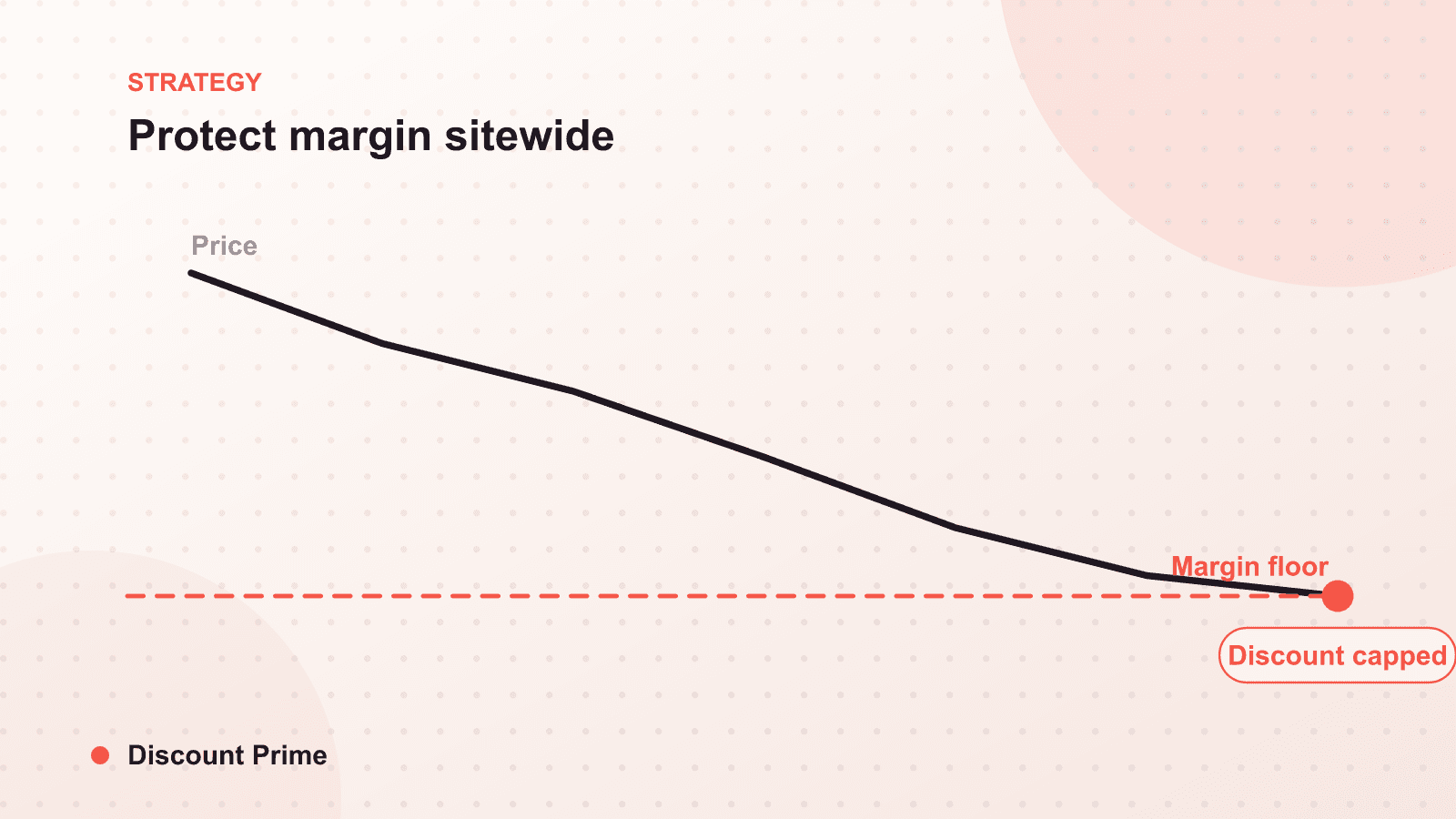
A sitewide sale is the bluntest instrument in retail, and the stores that survive it are the ones that quietly made it less sitewide than it looks.
A sitewide sale can protect your margin, but only if it is not actually applied to your entire site. The word "sitewide" is a marketing promise to the customer, not a technical instruction to your discount engine. The stores that come out of a big sale with their margin intact all do the same thing: they present one clean offer to shoppers while, underneath, a handful of products and collections quietly sit it out, and combinations are capped so the depth never compounds. This post is how to build that gap between what the customer sees and what your margin actually experiences.
The core problem with a true sitewide discount is that it applies one depth to products that have wildly different margins. A flat 25 percent off treats your 65 percent margin bestseller and your 28 percent margin accessory identically. The bestseller barely notices. The accessory is now selling at a small loss, on every order, for the length of the sale. Multiply that across your thin-margin tail and the sale can be a net winner on revenue and a net loser on profit at the same time.
Set the depth against your worst included product
Most stores set sale depth against a feeling, or against their blended average margin. Both are wrong. Set it against the thinnest-margin product you are willing to include.
Work it as a floor. Take your lowest-margin included item, subtract product cost, shipping subsidy, transaction fees, and packaging from its price, and express the remainder as a percentage. That is the deepest the sitewide discount can go before that product sells at a loss. If your worst included product has 30 percent contribution margin, a 30 percent sale is its break-even and anything deeper is red. If you want to go deeper than your tail can survive, the answer is not a shallower sale for everyone. It is to exclude the tail.
Exclude the products that cannot absorb it
Exclusions are the single highest-leverage margin protection in a sitewide sale, and they cost you almost nothing in customer goodwill because shoppers judge a sale by its headline and its bestsellers, not by whether one accessory is discounted.
Exclude, at minimum:
- Your lowest-margin tier. The products where the sale depth exceeds contribution margin. These are the ones bleeding on every order.
- MAP-restricted products. Anything under a manufacturer's minimum advertised price policy, where discounting risks the relationship or violates terms.
- Brand-new arrivals. Products selling fine at full price do not need the discount, and including them just donates margin.
- Gift cards. Never discount stored value. A discounted gift card is a discount you pay for twice.
Carve out collections instead of tagging one by one
If a whole category cannot take the depth, exclude the collection, not the products inside it individually. A collection carve-out is one rule instead of fifty tags, and it stays correct as you add products to that collection during the sale. Premium lines, MAP-restricted brands, and a new-season collection are all natural carve-outs. The customer still sees a storewide sale. Your margin sees a fenced one.
Cap the combinations so depth cannot compound
The quietest margin leak in any sale is stacking. A 25 percent sitewide sale that combines with a leftover 15 percent welcome code and a free shipping threshold is not a 25 percent sale on that order. It is 40 percent plus subsidized shipping, and it lands on whichever customer happens to hold the code.
Set explicit combination rules: decide whether the sitewide discount can stack with product, order, or shipping discounts, and default to not. If you do allow one additional offer, cap it at a single shallow one you have margin-tested together. Then prove it in an incognito cart by building an order that qualifies for everything at once and watching what actually applies.
A worked example
Say a sitewide 25 percent sale runs across 400 products. Your margins range from 28 to 65 percent. Here is the difference exclusions make on the tail.
| Approach | Products included | Depth | Result on the thin tail |
|---|---|---|---|
| True sitewide | All 400 | 25 percent flat | ~40 products sell at a loss the whole sale |
| Protected sitewide | 360, thin tail excluded | 25 percent flat | Every included product stays profitable |
| Over-corrected | All 400 | 12 percent flat | Nobody loses money, but the sale is too weak to convert |
The protected version keeps the depth customers respond to and removes only the products that could not survive it. That is almost always better than shallowing the whole sale to protect a few items.
Measure the blended margin, not the revenue
After the sale, revenue will look great. It always does. The number that tells you whether the sale worked is blended margin: total profit after all discounts, across every order the sale touched. A sale can lift revenue and lower blended margin at the same time, and you cannot see that without looking. This is exactly what post-sale reporting is for, and it is how you decide whether next quarter's sale should be deeper, shallower, or narrower.
Setting this up with Discount Prime
Discount Prime lets you build a sitewide offer with product and collection exclusions, then set combination rules so it does not stack past your floor. If your offer rewards larger orders, volume discounts can do some of the work a flat markdown does, at better margin, by tying the discount to basket size. Afterward, our analytics show the blended margin the sale actually earned so you are not flying on revenue alone. For the strategy layer, see deep or wide but not both, and for keeping sales from training your customers to wait, read how to run a sale without training customers to wait.