In dropshipping, the price you charge and the price you pay move independently, and your margin is whatever survives the gap between them.
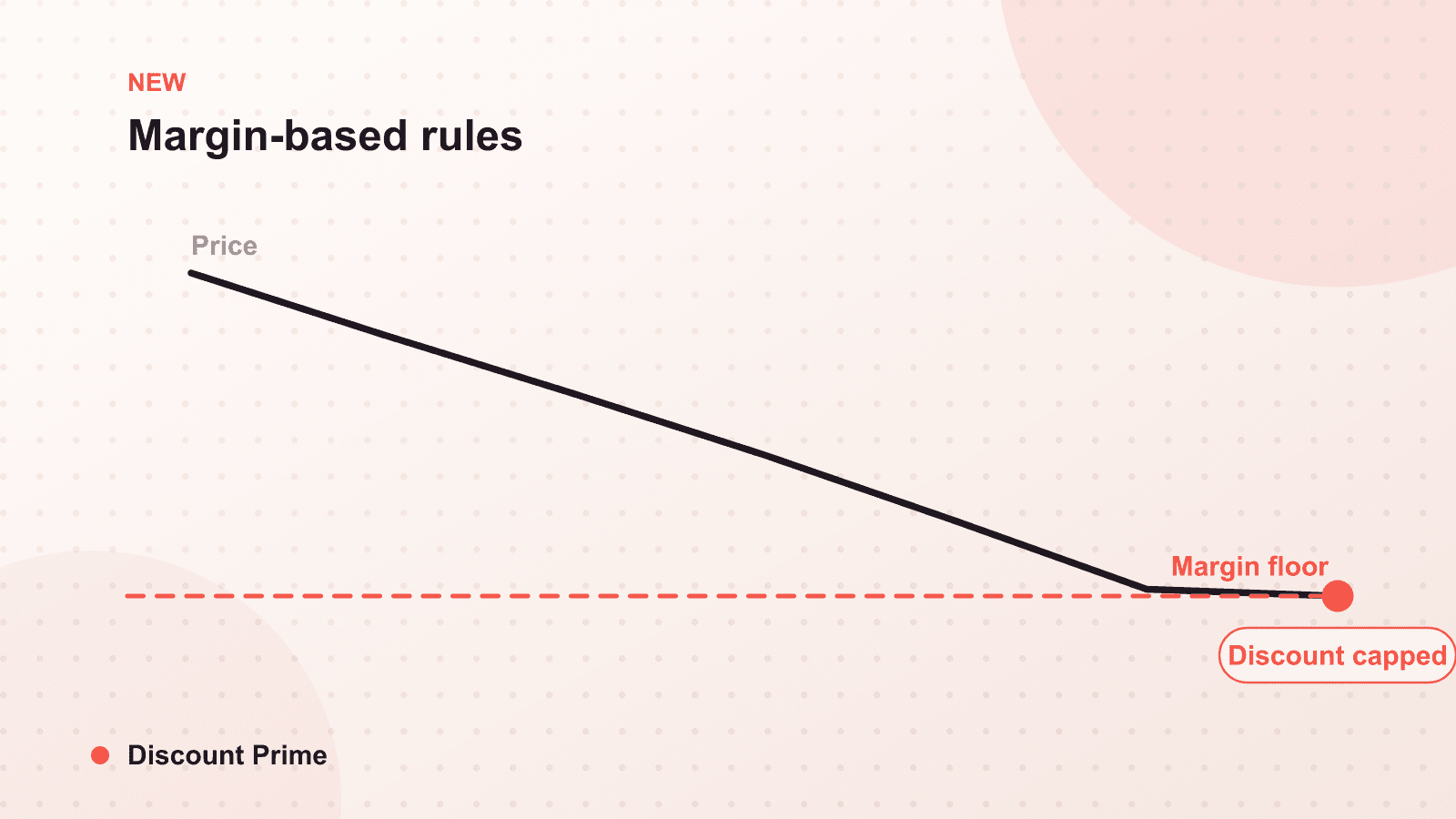
Today we are shipping margin-based pricing rules in Discount Prime. Instead of setting a discount as a fixed percent off, dropshippers can now set it as a target margin. You tell the app the profit you want to keep, and it works out the price from the product's cost. When a supplier changes what they charge you, the sale price moves with it, so the deal never quietly slips below the margin you decided on.
This is the feature dropshippers have been asking us for since we shipped profit analytics last month. Analytics showed you which discounts made money after the fact. Margin-based rules stop the unprofitable ones from running in the first place.
What a margin-based pricing rule does
A margin-based rule prices from the bottom up. You set a target gross margin, for example 25 percent, and the app computes the sale price for each product from its cost of goods. A percentage discount does the opposite: it starts from your retail price and subtracts, with no knowledge of what the item actually costs you.
That difference matters most when costs are not uniform. Dropshipping catalogs almost never have a single markup. One supplier ships at one cost, a second variant costs more, and prices drift over a season. A margin rule reads the live cost per variant and holds your profit across all of it. One rule covers a catalog that a percentage discount would need constant babysitting to keep safe.
Why fixed percentages are dangerous for thin margins
Here is the failure that margin-based rules exist to prevent.
Say you run 30 percent off a $40 product that costs you $26. That leaves you $2 per unit. Thin, but positive. Then your supplier raises the item cost to $30 for the next batch and you do not catch it. The same 30 percent rule now sells at $28 against a $30 cost. You are paying customers $2 to take the product, and nothing in Shopify warned you.
With a margin-based rule set to a 15 percent floor, that never happens. When the cost moves to $30, the app recomputes the sale price to keep your 15 percent, so the price rises to roughly $35 on its own. You keep the margin you chose, and the customer still sees a real discount off the list price.
A worked example
Two variants of the same product, different supplier costs, one margin rule set to 20 percent.
| Variant | Your cost | Fixed 30% off ($50 list) | Margin rule at 20% |
|---|---|---|---|
| Standard | $28 | $35.00 (20% margin) | $35.00 |
| Premium | $36 | $35.00 (loses $1) | $45.00 (20% margin) |
The fixed discount treats both variants the same and sells the premium one at a loss. The margin rule prices each variant from its own cost, so both hold 20 percent. You set the intent once, and the math follows the cost.
Setting it up
Margin-based rules live on the dropshipper pricing page in Discount Prime. Two things need to be true before you switch one on. First, cost per item has to be filled in on your variants in Shopify, since the rule prices from that field. Second, decide the margin you are willing to defend, not the one you hope for on a good day. The rule protects whatever number you give it.
Once it is live, the pricing applies through Shopify Functions in cart and checkout on every plan, and you can watch the result in profit analytics to confirm the margin is holding across your catalog. If you have not thought through why dropshipping margins need this kind of guardrail, our earlier piece on why dropshipping margins are thin sets up the reasoning, and the profit analytics launch explains the reporting side.
Margin should not be something you discover at the end of the month. Now it is something you set at the start.