A 20% discount is a rounding error on a 60% margin product and a going-out-of-business decision on a 12% margin one. Flat discounts cannot tell the two apart. That is the whole problem with discounting a dropshipping catalog.
Dropshipping is the hardest place to discount well, because there is almost no room for error. Your margins are thin by design: you buy single units at close to retail, pay shipping and fees on every order, and spend on ads to acquire the customer in the first place. By the time a sale lands, the profit on it can be a few dollars. Take a flat percentage off the top and that profit can vanish, or go negative, without anything on your dashboard looking wrong. This post is about why flat discount rules break on thin margins, and what to do instead.
The direct answer: stop applying one discount depth across your whole catalog. On a mixed-margin catalog, the discount each product can afford is different, and it is set by that product's own margin. Cost-aware pricing sizes the cut to the product instead of the promotion, so no order crosses break-even.
Why dropshipping margins leave no room
A traditional retailer buys in bulk, so their unit cost is well below what they charge, and a discount eats into a comfortable spread. A dropshipper does not get that spread. You pay a per-unit supplier price with little or no volume discount, then stack shipping, payment processing, and customer acquisition on top. The result is a gross margin that is often in the single digits to low double digits before ad spend even enters the picture.
That thinness is the defining constraint. On a 50% margin product, a 20% discount cuts your profit but leaves you well in the black. On a 12% margin product, a 20% discount is mathematically impossible to survive: you are selling below cost. The exact same promotion is prudent on one product and fatal on another, and the only thing that changed is the margin underneath.
Why flat percentage discounts are the trap
The default way stores discount is a flat number: 20% off sitewide, 15% off this collection. It is simple, and on a healthy-margin catalog it is fine. On a thin, mixed-margin dropshipping catalog it is a quiet disaster, because a flat percentage is blind to the one thing that matters, which is each product's margin.
Here is what a flat 25% sitewide sale does across three products:
| Product | Price | Loaded cost | Margin | After 25% off | Result |
|---|---|---|---|---|---|
| A | $40 | $18 | $22 (55%) | $30 price, $12 margin | Healthy |
| B | $40 | $28 | $12 (30%) | $30 price, $2 margin | Barely alive |
| C | $40 | $34 | $6 (15%) | $30 price, negative $4 | Loss per order |
Same price, same discount, three completely different outcomes. Product C now loses four dollars every time it sells, and it may well be your bestseller, because the sale is driving volume to it. The flat rule cannot see any of this. It treats all three as equal and lets your thinnest product bleed.
The fix: size the discount to the margin
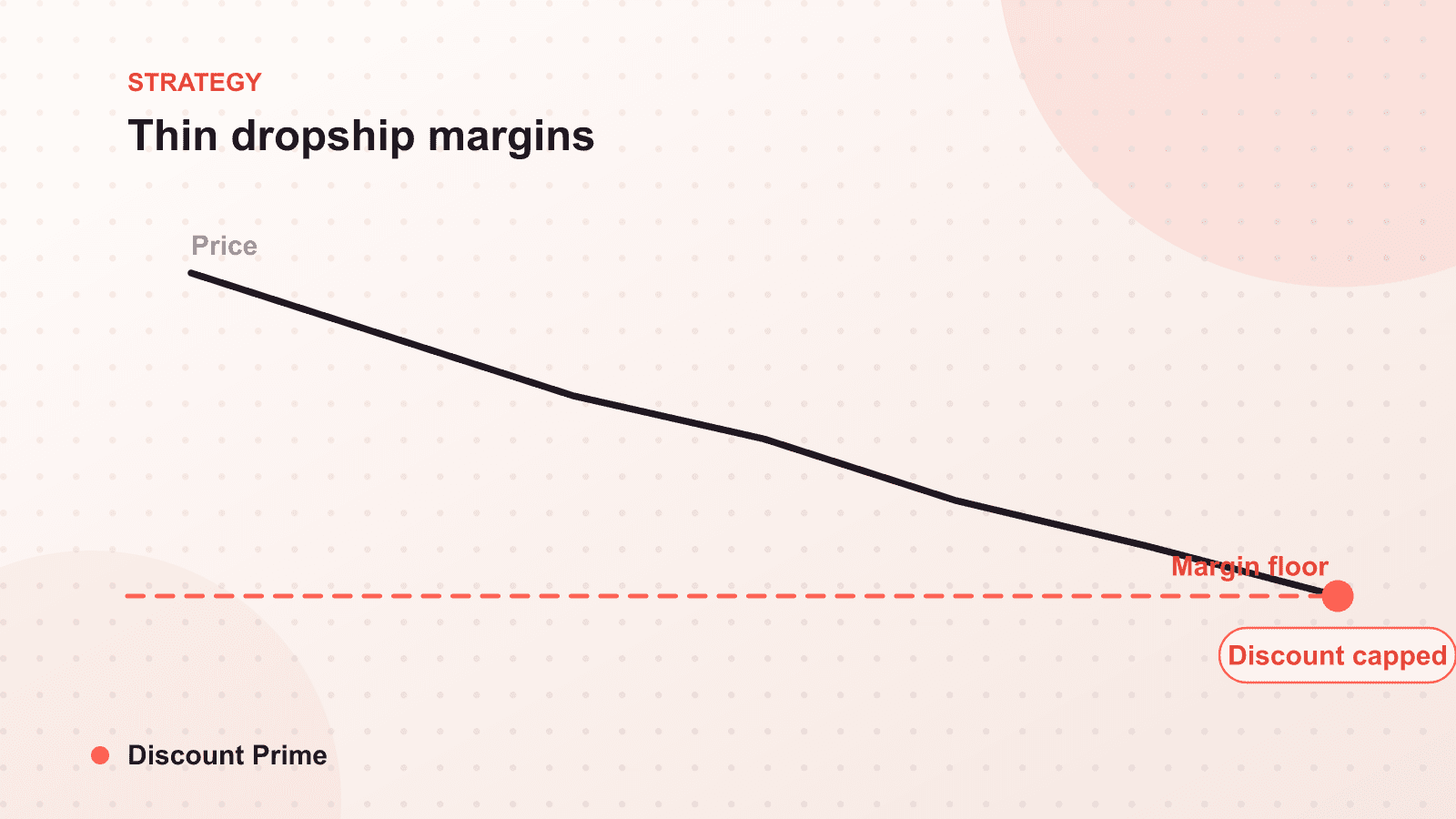
The alternative is cost-aware pricing: instead of one depth for everything, the discount is anchored to each product's margin. High-margin products can take a deep, attention-grabbing cut. Thin-margin products get a shallow discount or none. Every discount is bounded by a margin floor, so nothing crosses break-even no matter how the promotion is framed.
This requires two things you may not have yet. First, an accurate, fully loaded cost per product, including freight, duties, and per-unit fees, not just the supplier invoice. We wrote the full method in COGS on Shopify, and on a thin catalog it is not optional. Second, reporting that shows margin per campaign, so you can catch a loss before you repeat it. That is what profit analytics is for, and it exists precisely because thin-margin stores cannot afford to discount blind.
What to run instead of flat sitewide cuts
Until every discount can be sized to margin automatically, favor discount types that lift order value rather than just cutting price:
Behavior-based offers. A volume tier or a free shipping threshold rewards the customer for buying more, so the discount is paid for by a larger order rather than subtracted from a thin one. The margin math changes in your favor because average order value rises.
Deep cuts only on high-margin lines. Reserve your loud, headline discounts for the products that can actually absorb them, and leave your thin-margin products at or near full price. Your promotion still looks generous; it just points customers at the products where a discount makes sense.
A hard margin floor on everything. Whatever else you do, set the lowest margin you will accept per order and make it a rule, not a hope. On a thin catalog the floor should be doing real work, catching the tier that would have tipped a product negative.
Where this is heading
Sizing a discount to each product's margin by hand, across a catalog of hundreds of items, is not realistic. It is arithmetic no one has time to redo every time a supplier price moves. That is exactly the gap we are building toward closing next: pricing rules that read a product's margin and set the discount accordingly, so the cost-aware logic in this post becomes automatic rather than manual. We will have more to say on that shortly in margin-based pricing rules for dropshippers. Getting your cost data clean now is the prerequisite for all of it.
Setting this up with Discount Prime
Discount Prime already gives thin-margin stores the two things they need most: accurate margin on every campaign through profit analytics, and behavior-based discounts that lift order value instead of just cutting price. The cost-aware pricing built around this is what our dropshipper pricing approach is all about, and it runs on Shopify Functions on any plan. Get your costs in, set your floor, and stop letting flat discounts decide which of your products lose money. You can find the app on the Shopify App Store.