The empty coupon field at checkout is one of the most expensive boxes in ecommerce. Half the customers who see it leave to go find a code.
Automatic discounts and discount codes do the same job, they lower a price, but they behave differently at the two moments that matter: when the customer decides to buy, and when you try to figure out whether the promotion worked. Neither is universally better. The right answer depends on whether you value friction reduction or campaign control more for a given offer.
Here is the short version. Automatic discounts apply themselves the instant the cart qualifies, so they remove the friction step and the "search for a coupon" detour, which usually helps conversion. Discount codes give you a token you can track, gate, and hand out per channel, which usually helps everything downstream of the sale. Choose based on what the specific promotion needs to do.
What each one is
An automatic discount applies without any action from the customer. You set a condition, such as "10 percent off orders over $75" or a quantity tier, and Shopify applies it in the cart for anyone who qualifies. There is no field to fill, no code to remember, nothing to leak.
A discount code is a token the customer enters at checkout, or arrives with pre-applied from a link. The code is the point. It lets you tie the discount to a campaign, restrict it to a segment, cap its uses, and run different offers on different channels at the same time.
Both run through the same underlying discount engine on Shopify. On modern stores, custom logic for either one is powered by Shopify Functions, which is why quantity tiers and storewide offers can apply automatically on any plan without Scripts.
The friction difference
The strongest argument for automatic discounts is the coupon field itself.
When a customer sees an empty "discount code" box at checkout and does not have a code, a meaningful share of them pause, open a new tab, and go looking. Some come back. Some find a better code on a deal site. Some get distracted and never return. The box advertises that a discount exists and then makes the customer feel like they are missing it. An automatic discount removes that entire loop. The price is already lower when they reach checkout, and there is nothing to hunt for.
Codes have the opposite dynamic, and it can work in your favor. A customer who arrives from your email with a code already in hand feels like they earned something specific. The code makes the offer feel personal and deliberate rather than available to everyone. The friction is real, but so is the sense of a deal claimed rather than a discount stumbled into.
The attribution difference
This is where codes pull ahead. A code is a label. When an order used SPRING20, you know which campaign, email, or influencer drove it. You can run PODCAST15 and NEWSLETTER15 at the same time and tell them apart. Automatic discounts have no such tag. Anyone who qualifies gets the offer, so you cannot separate the customer who came for the promotion from the one who would have bought anyway.
For a storewide "spend more, save more" mechanic, that ambiguity does not matter much, because the offer is the store policy, not a campaign. For a targeted push you want to measure and repeat, the code's trackability is the whole point.
The leak-risk difference
A public code can travel. Post it once and it can end up on a coupon aggregator, in a Reddit thread, or in a browser extension that auto-tries codes at checkout. Now the discount you built for newsletter subscribers is discounting orders from people who never subscribed. Automatic discounts cannot leak this way, because there is no code to share. If you need an offer to stay inside a segment, that is an argument for either a gated code or a targeted automatic discount, not a public code.
Side by side
| Dimension | Automatic discount | Discount code |
|---|---|---|
| Customer effort | None, applies in cart | Must enter or click a code |
| Checkout friction | Low, no empty coupon field | Higher, prompts code-hunting |
| Attribution | Weak, no per-campaign token | Strong, one token per campaign |
| Gating to a segment | Only by cart conditions | Easy, restrict code to a group |
| Leak risk | None, nothing to share | Real, public codes travel |
| Best for | Storewide, volume, and tiered offers | Targeted, measurable, gated campaigns |
| Feels like | Store policy | A deal you claimed |
When to use each
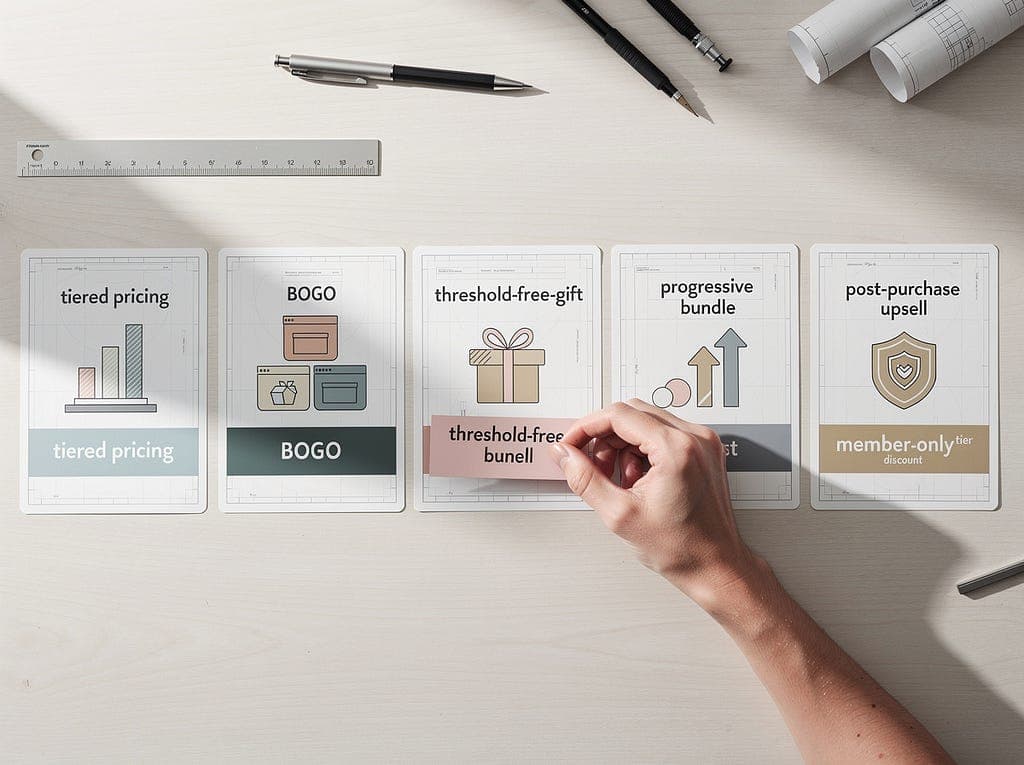
Use automatic discounts for offers that are really store policy: volume tiers, storewide thresholds, free shipping over a cart value, and tiered pricing ladders. These reward behavior you want from everyone, so there is no reason to make the customer work for them, and no campaign to attribute. Our guides to volume discounts and structuring tiers customers understand cover how these apply on the product page and in cart.
Use discount codes when the token is doing real work: attributing a channel, gating an offer to subscribers or wholesale accounts, capping redemptions, or running several offers at once you need to tell apart. If you cannot answer "which campaign did this sale come from," you probably wanted a code.
Use both, deliberately. Many stores run an automatic baseline (volume tiers, always on) and layer coded campaigns on top for specific pushes. The moment you do that, the combination settings matter. Shopify's discount combinations let you decide whether a code can stack on top of an automatic offer. Set it on purpose, because an automatic tier that quietly combines with a forgotten code can discount far deeper than you intended.
A quick worked example
Say you run an always-on volume tier: buy 3, save 10 percent, applied automatically. Then you send a newsletter with WELCOME15. If those two combine, a subscriber buying 3 units gets 10 percent plus 15 percent, roughly 23.5 percent off, not 15. On a product with 40 percent gross margin, that is the difference between a healthy order and a thin one. The fix is not to avoid running both. It is to decide up front whether the code combines with the tier, and to configure that rather than discover it later.
Setting this up with Discount Prime
Discount Prime runs both models through Shopify's native engine. Volume and tiered pricing offers apply automatically on the product page and in cart with no code to leak, and you control exactly what combines with what. Start with your always-on automatic tiers, then layer coded campaigns on top only where you need attribution or gating, and set the combination rules on purpose.