Free shipping is not a discount you give. It is a bet that a shopper will spend more to avoid paying for shipping, and the bet only pays if you place the line correctly.
Free shipping pays for itself when the extra margin from a larger cart is greater than the shipping cost you absorb. That is the entire test. Everything else in this article is about the two ways stores get that test wrong: setting the threshold too low, so free shipping becomes a silent discount on orders that would have happened anyway, and forgetting to check whether the item that clears the threshold actually earns enough margin to cover the shipping.
If you are running or considering a free shipping threshold on Shopify, this is the math you need before you turn it on.
The core idea: buy incremental spending, not existing orders
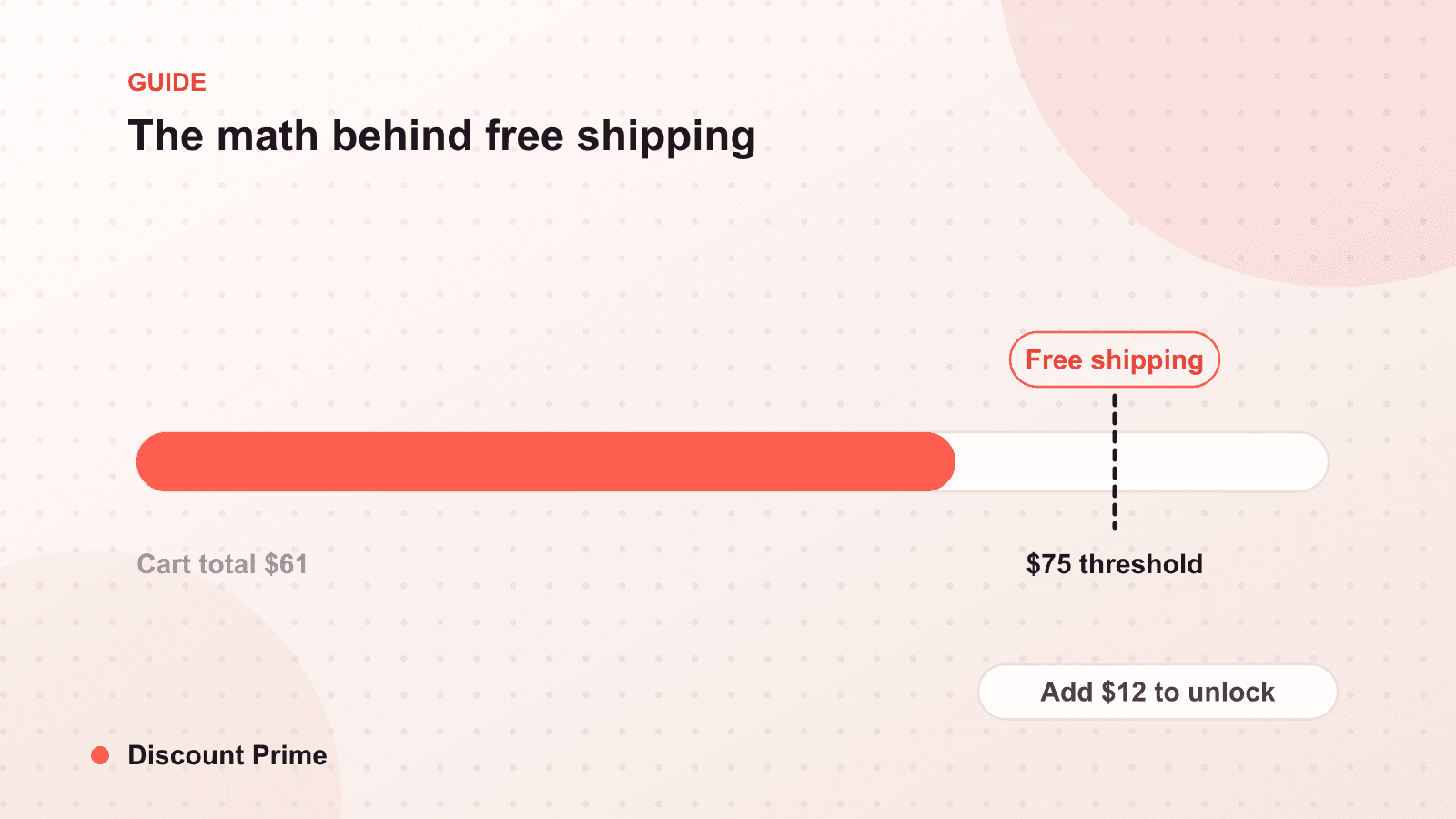
A percentage-off code discounts every order it touches. A free shipping threshold is more surgical. It only pays out on carts that reach the threshold, and the useful ones are the carts that grew to reach it. When a shopper adds a second item specifically to clear "add $12 for free shipping," you bought that extra item at the cost of the shipping you waived. That is a good trade if the item's margin beats the shipping cost.
The trap is the cart that was already above your threshold. That shopper gets free shipping for a behavior they had already committed to. You paid, and nothing changed. The more of your normal orders sit above the threshold, the more of your free shipping budget goes to orders you already had.
This is why the single most important decision is where the threshold sits relative to your average order value.
Setting the threshold above AOV
Find your average order value first. Then set the free shipping threshold above it, usually 15 to 30 percent higher. The gap between AOV and threshold is the distance you are asking the average shopper to travel, and it should be small enough to close with one reasonable addition.
- If your AOV is $40, a threshold near $50 asks for one modest item.
- If your AOV is $40 and you set the threshold at $35, almost every order qualifies automatically, and you have simply started paying for shipping on your entire order volume.
- If your AOV is $40 and you set the threshold at $90, most shoppers cannot plausibly get there, so the bar stops motivating and the offer does little.
The sweet spot is a target most shoppers can see themselves reaching. Too low and it is a giveaway. Too high and it is wallpaper.
A worked example
Say the numbers are:
- Average order value: $40
- Your shipping cost to fulfill a typical order: $6
- Your gross margin: 50 percent
- Threshold you set: $52
A shopper arrives with a $40 cart. The bar reads "add $12 for free shipping." They add a $16 item to clear it. Now:
- New order value: $56
- Added revenue: $16
- Added margin at 50 percent: $8
- Shipping you absorb: $6
- Net gain on this order: $8 minus $6, which is $2
You came out ahead, but not by much, and only because the added item earned $8 of margin against $6 of shipping. Change one input and the picture flips. If your margin were 30 percent, the added item earns just $4.80, and absorbing $6 of shipping turns the incremental order into a $1.20 loss. The threshold that "works" at 50 percent margin loses money at 30 percent.
This is the calculation to run before launch: for a typical item that would clear your threshold, does its margin cover your shipping cost with room to spare? If not, either raise the threshold so the clearing item is bigger, or accept that you are using free shipping as a conversion tool rather than a profit-neutral one, and price that decision honestly.
Free shipping vs a percentage discount
| Free shipping threshold | Percentage-off code | |
|---|---|---|
| Who it rewards | Carts that grow to reach the line | Every qualifying order |
| Targets incremental spending | Yes, when set above AOV | No, discounts existing orders too |
| Effect on AOV | Pushes carts up toward the target | Neutral or can lower it |
| Margin predictability | Fixed shipping cost per qualifying order | Scales with order size |
| Best use | Nudging order value on margin-healthy items | Broad promotions, clearing inventory |
Neither is strictly better. A percentage code is the right tool for a sitewide promotion or a clearance push. A free shipping threshold is the more efficient tool when your goal is to lift order value without discounting the orders you already had.
When free shipping loses money
Three failure modes, in order of how often we see them:
- Threshold at or below AOV. You pay shipping on orders that were already happening. This is the most common and the most expensive mistake.
- Thin-margin clearing item. The item shoppers add to reach the threshold earns less margin than the shipping you waive. The incremental order is a loss even though it looks like a win.
- Uncontrolled stacking. Free shipping combined with another discount can push a qualifying order below cost. Decide combination rules deliberately; the free shipping progress bar we shipped in December uses Shopify's discount combination controls so you can choose whether it stacks.
Setting this up with Discount Prime
Discount Prime applies free shipping as a native automatic discount, so you set a threshold once and a live progress bar shows each shopper their distance to it. Point the threshold just above your average order value, pair it with volume discounts on the products people buy in multiples, and the two offers push order value from the same direction. You can install the app from the Shopify App Store and have a first threshold live in a few minutes.