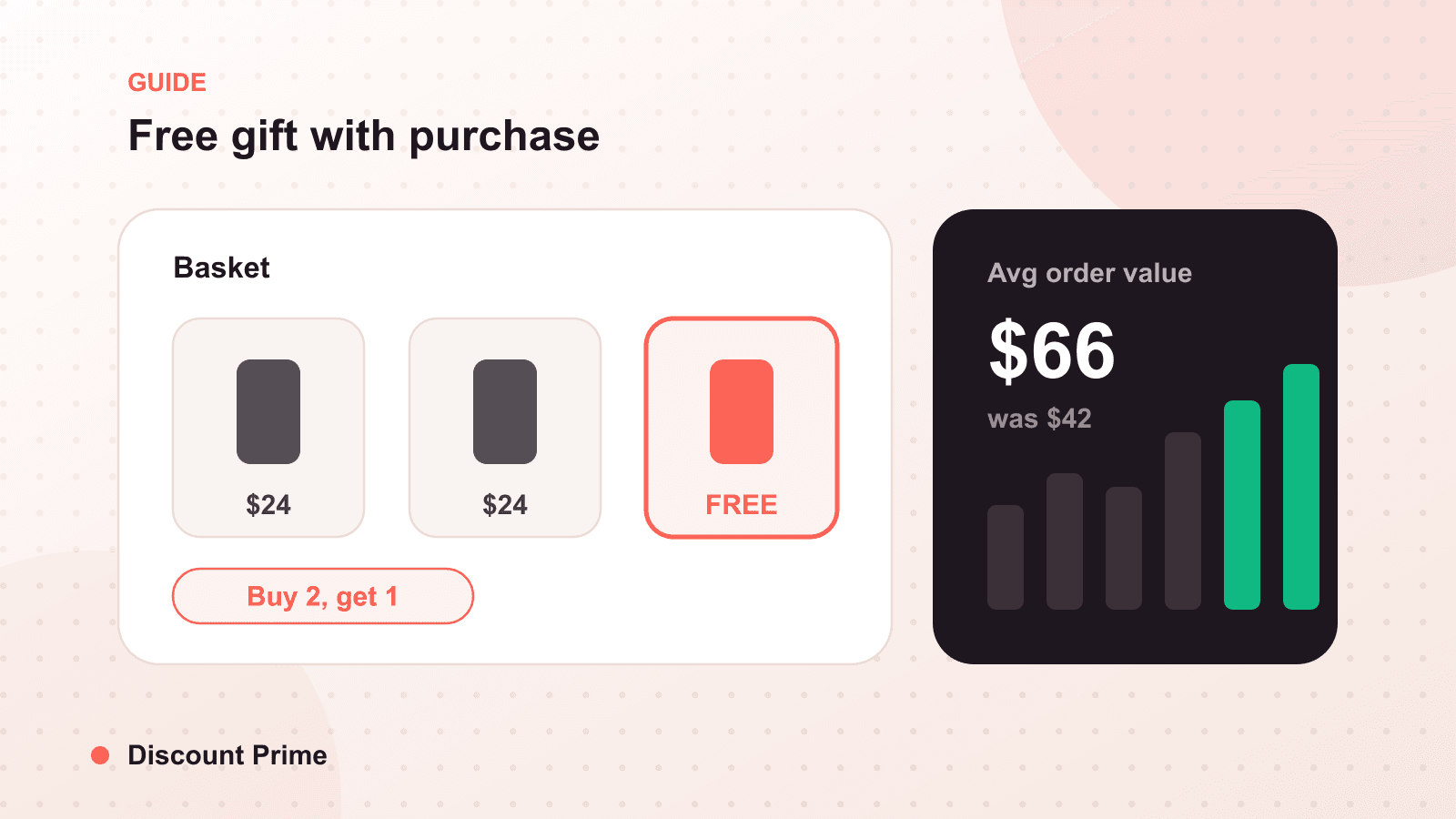
A free gift feels generous to the customer and free to the merchant. Only one of those is true.
Free gift with purchase is one of the most effective promotions in ecommerce and one of the easiest to run at a loss without noticing. Done right, it lifts average order value and moves slow inventory while the customer feels rewarded rather than discounted. Done wrong, it hands a costed item to orders that would have happened anyway. The difference is entirely in the mechanics and the margin math, so this guide covers both.
The direct answer up front: a gift with purchase pays for itself only when the threshold that triggers it creates more incremental margin than the gift costs you at landed cost. Everything below is how to make that true.
What a free gift with purchase actually is
A free gift with purchase adds a designated item to the cart at no charge once the order meets a condition. The condition is usually a spend threshold ("free gift on orders over $75") or a qualifying product ("free travel size with any full size"). On Shopify, it is built as a Buy X Get Y style rule through Shopify Functions, so the gift is added and priced at zero inside the native cart and checkout, no duplicate free product listing or manual code required.
Mechanically it is close to a BOGO offer, and the same design principles apply: the reward has to be clearly tied to the purchase, and the customer has to understand it without reading fine print. Our guide to Buy X Get Y mechanics covers the clarity side in depth. This post is about the money.
Where to set the threshold
The threshold is the entire economic engine of the offer, and most stores set it wrong by setting it too low.
If your average order value is $60 and you offer a free gift over $50, you are giving the gift to nearly every order, including the ones already above $50 that needed no encouragement. You just added cost to purchases you were getting at full margin.
Set the threshold above your current AOV. If AOV is $60, a $75 threshold asks the customer to add roughly one more item to qualify. Now the gift is buying something: the incremental spend between $60 and $75. That incremental spend carries margin, and that margin is what funds the gift.
The rule: the threshold should stretch the order, not reward the default. This is the same logic that governs volume tiers and free shipping bars, and it is the single most common place gift offers leak money.
The margin math, worked
Here is the calculation that decides whether the offer is a promotion or a slow loss.
Say your AOV is $60 and you set the gift threshold at $75. Your blended contribution margin is 45%, so every extra dollar of sales adds 45 cents of margin. The gift is a house-brand accessory that retails for $20 but costs you $5 landed.
| Item | Value |
|---|---|
| Threshold above AOV | $75 minus $60 = $15 incremental spend |
| Margin on incremental spend | $15 x 45% = $6.75 |
| Cost of the gift | $5.00 |
| Net margin gain per lifted order | $6.75 minus $5.00 = $1.75 |
On every order the offer successfully lifts, you net $1.75 and the customer feels they got a $20 gift. That is the shape of a healthy gift with purchase: the customer's perceived value ($20) is far above your cost ($5), and the incremental margin covers the cost with room to spare.
Now watch it break. Cost the gift at its $20 retail value instead of its $5 landed cost and you would wrongly conclude the offer loses $13.25 per order and kill it. Or set the threshold at $50, below AOV, and the $6.75 of incremental margin never appears, so every gift is a straight $5 cost with nothing funding it. Same offer, two ways to misread it, both fatal.
The two numbers that matter: cost the gift at landed cost, and place the threshold so it creates incremental margin larger than that cost.
Choosing the gift
The ideal gift has a low landed cost and a high perceived value. A sample, a branded accessory, or a house-brand product the customer would not otherwise try all qualify. They feel like a genuine reward and cost you little.
Two items to avoid. Do not gift your hero product, the thing people already come to buy at full price. Give it away and you teach customers to wait for the gift promotion instead of paying for it, cannibalizing your best margin. And do not gift anything whose landed cost is high enough that the margin math only works on your largest orders; a gift that only pencils out above $150 on a store with a $60 AOV is not a gift-with-purchase offer, it is a whale reward.
Treat gift SKUs as real inventory
The most common operational failure is treating the gift as an untracked add-on. It is a real unit leaving your warehouse, so it needs a real SKU with real stock.
Two rules keep it clean. Cap the campaign to the gift stock you actually have, so a popular offer does not promise a gift you cannot ship. And set the rule to add at most one gift per qualifying order, so a single large cart cannot claim several. Then reconcile gift inventory the same way you reconcile sellable stock. A gift you ran out of mid-campaign is a customer service problem wearing a promotion costume.
While you are at it, decide how the gift interacts with other offers. If it can stack with a code or a volume tier, the effective cost of an order changes, and unplanned stacking is one of the discount abuse patterns that quietly widens the leak. Set the combination behavior deliberately.
Measuring whether it worked
After the campaign, check three things in your profit analytics: did AOV on qualifying orders actually rise toward the threshold, did margin per order hold after subtracting gift cost, and what share of orders clustered just above the threshold (evidence customers responded to it rather than clearing it by accident). If AOV did not move, the threshold was too low or the gift too weak. If margin fell, the gift cost more than the lift it created.
Gift with purchase is not a giveaway. It is a trade: you give a low-cost, high-perceived-value item in exchange for incremental spend that carries more margin than the gift costs. Set up the mechanics with a real threshold, a real SKU, and honest landed-cost math, and it is one of the few promotions that can grow orders and protect margin at the same time. For thresholds specifically, it pairs naturally with a free shipping bar, giving customers two reasons to add one more item.