BOGO does not fail because it is too generous. It fails because the customer cannot tell what they have to buy, or what they actually get.
A Buy X Get Y offer works when three things are unmistakable: what the customer must buy, what they receive in return, and how many times the deal applies. Get those three right and BOGO is one of the most effective promotions in ecommerce. Get any of them fuzzy and you produce two problems at once: shoppers who abandon because they cannot tell if they qualify, and a giveaway that multiplies past what you planned.
This guide covers the mechanics of Buy X Get Y on Shopify, the structures worth running, and the specific ways these offers confuse customers or quietly bleed margin.
What Buy X Get Y actually is
Buy X Get Y is any promotion where buying a qualifying item or quantity, the trigger, unlocks a discount or free item, the reward. BOGO (buy one get one) is the famous case, but the family is broader:
- Buy one get one free. Buy 1, get a second identical unit free.
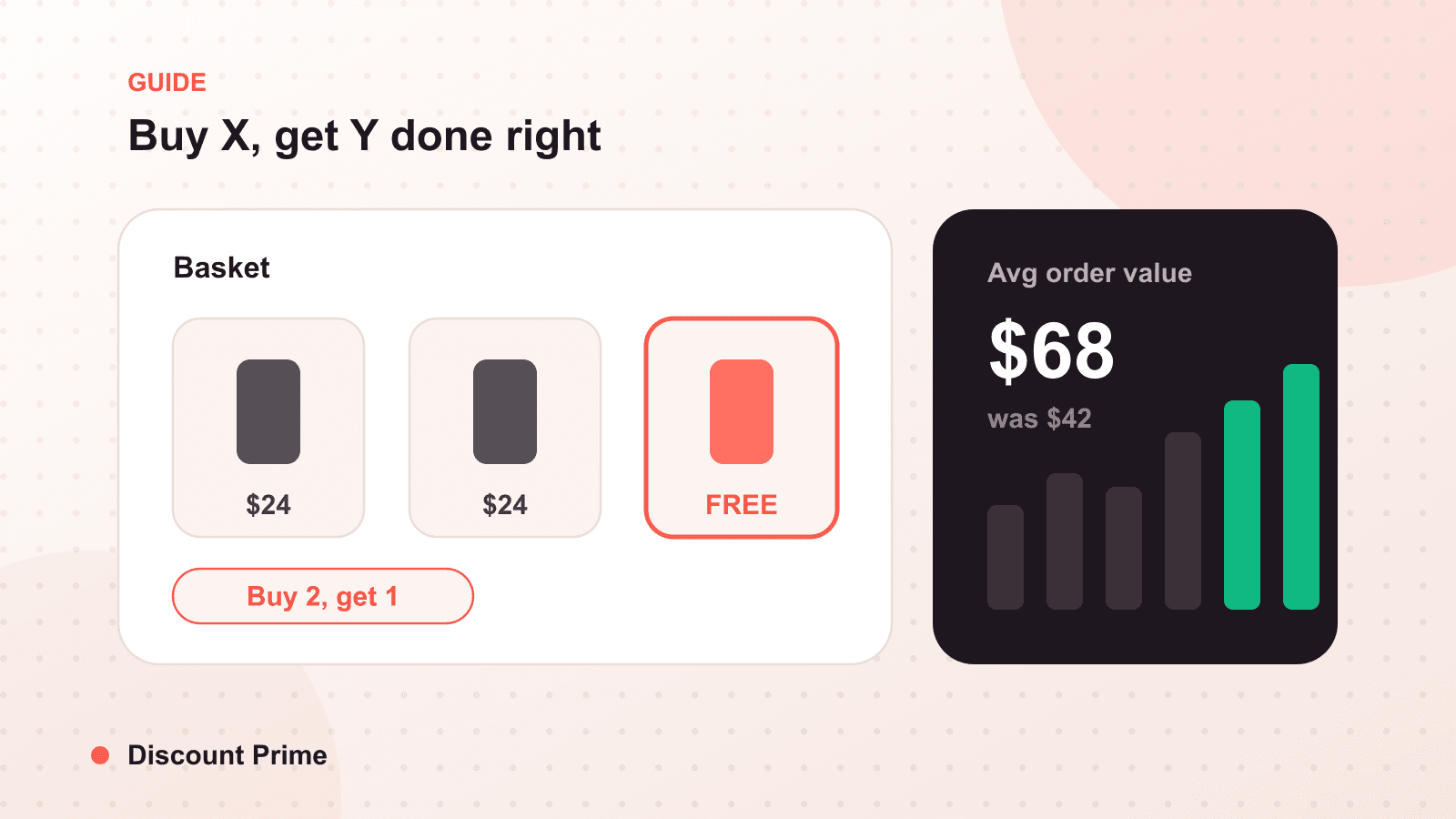
- Buy 2 get 1 free. Buy 2, get a third free. Common for consumables.
- Buy X get Y at a percentage off. Buy 1 full-price item, get a related item at 50 percent off.
- Gift with purchase. Buy a qualifying item, get a specific free gift SKU added.
Every one of these is the same underlying logic: a trigger the shopper must satisfy, and a reward they receive when they do. Keeping those two ideas cleanly separated in your head, in your setup, and in your storefront copy is most of what "done right" means.
The trigger and the reward, kept separate
The single most common source of BOGO confusion is blurring the trigger and the reward. The shopper needs to answer two questions instantly: "What do I have to put in my cart?" and "What do I get for it?"
Define the trigger precisely. Is it any product, a specific product, a collection, or a quantity? "Buy 2 of anything in this collection" is a clear trigger. "Buy stuff to get a deal" is not. The trigger should be something a shopper can look at their cart and verify.
Define the reward precisely. Is the reward a free identical unit, a specific gift SKU, or a discount on a different item? "Get a third of the same free" is clear. "Get something free" invites a support ticket. If the reward is a different product, make sure it is one the shopper would actually want, or the offer does not motivate anyone.
When these two are crisp, the storefront copy writes itself: "Buy 2, get the 3rd free." When they are not, no amount of banner design rescues it.
Cap the reward, always
The margin failure mode is the uncapped reward. "Buy 1 get 1 free" with no per-order limit sounds fine until a shopper puts twenty triggers in the cart and walks away with twenty free units. On a thin-margin product, one uncapped order can erase the profit from many normal ones.
Set a per-order limit on how many rewards a single order can earn. Most well-run BOGO offers cap the reward at one, or at a small number, per order. The cap is not stinginess; it is the difference between a promotion you can forecast and one that surprises you at reconciliation.
Margin math on a worked example
Say you run "buy 2 get 1 free" on a $20 product with 50 percent margin (cost $10).
- A shopper buys 3, pays for 2 ($40), gets 1 free.
- Revenue: $40. Cost of goods for 3 units: $30. Gross profit: $10.
- Your margin on the order dropped from 50 percent to 25 percent, but the shopper bought 3 units instead of 1.
That trade is good if the promotion genuinely moves shoppers from one unit to three. It is bad if most of these shoppers were going to buy 2 anyway, because then you gave a free third unit to demand you already had. As with free shipping, the offer pays when it changes behavior, not when it subsidizes it. The comparison to keep in mind:
| Structure | Trigger | Reward | Best for | Margin risk |
|---|---|---|---|---|
| Buy 1 get 1 free | 1 unit | 1 free unit | New customer trial, clearance | High if uncapped |
| Buy 2 get 1 free | 2 units | 1 free unit | Consumables, stocking up | Moderate, cap it |
| Buy X get Y % off | 1 full-price item | Related item discounted | Attach rate, bundling | Lower, controllable |
| Gift with purchase | Qualifying item | Fixed free SKU | AOV lift, moving a gift SKU | Predictable if SKU is cheap |
Where Buy X Get Y beats a plain discount
A percentage-off code discounts whatever is in the cart. Buy X Get Y is directional: it pushes the shopper toward a specific action, buying more of a product or attaching a related one. That makes it a better tool than a flat code when your goal is to raise units per order or lift the attach rate on a companion product, rather than just lowering the price on what someone already wanted.
It also pairs naturally with volume discounts. A "buy 2 get 1 free" offer and a quantity tier at 3 units are two ways of rewarding the same behavior, and on consumables they reinforce each other.
Combination rules: decide before launch
Buy X Get Y runs on Shopify's discount engine, which means it obeys the discount combination settings. A BOGO that stacks with a percentage code or a volume discount can push the effective giveaway well past what you intended. Decide deliberately what a Buy X Get Y offer is allowed to combine with, and check the margin at the overlap. We covered how the combination rules resolve in discount stacking on Shopify; read it before you let a BOGO run alongside other active discounts.
Setting this up with Discount Prime
Buy X Get Y is exactly the kind of offer that belongs on Shopify's native discount engine, applied automatically, capped cleanly, with combination rules you control. It is next on our roadmap, and we go into the Buy X Get Y mechanics we are building on the feature page. Keep an eye on the blog: we announce it in new Buy X Get Y deals in Discount Prime. In the meantime, if you sell products people buy in multiples, volume discounts are live today and cover much of the same stocking-up behavior. You can find Discount Prime on the Shopify App Store.