
Dropshipping pricing simulator
By the Discount Prime team. Last reviewed November 7, 2026.
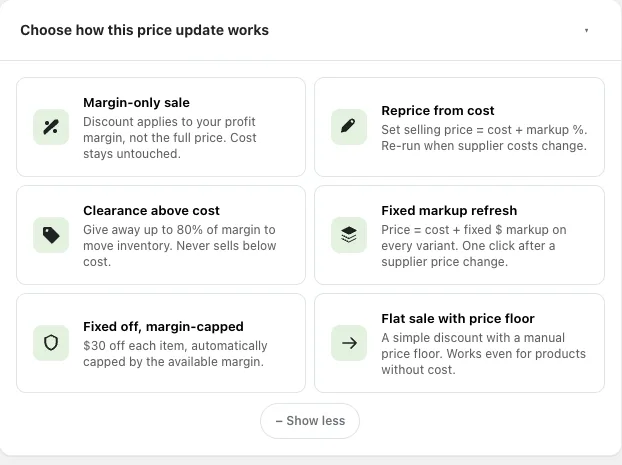
Pick one of Discount Prime's dropshipping templates, enter your products with their cost, and see the new price and the profit per unit. Discounts can come out of your margin instead of your price, a floor of cost plus a minimum profit holds every sale above cost, and a cost-plus markup reprices the catalog, all with the same rules as the app.
- Prices changed
- 3 of 4
- Average change
- -7.2%
- Smart watchNow $500.00
Storefront shows $480.00-4%
New compare-at: none
Profit per unit $100.00 (20%) to $80.00 (16.7%)
- No compare-at price, so the storefront shows no strikethrough.
- Phone standNow $50.00
Storefront shows $46.00-8%
New compare-at: none
Profit per unit $20.00 (40%) to $16.00 (34.8%)
- No compare-at price, so the storefront shows no strikethrough.
- Desk lampNow $35.00, compare-at $42.00
Storefront shows $31.60$42.00-9.7%
New compare-at: $42.00
Profit per unit $17.00 (48.6%) to $13.60 (43%)
- Cable kitNow $24.00
Skipped. No cost per item, and products without a cost are skipped.
- Products without a cost per item show no profit.
20% off the margin vs 20% off the price
A smart watch sells for $500 and costs $400 from the supplier. The same 20% means very different things:
| Based on | New price | Profit per unit | Margin |
|---|---|---|---|
| Profit margin | $480.00 | $80.00 | 16.7% |
| Selling price | $400.00 | $0.00 | 0.0% |
Off the margin, the shopper saves $20.00 and you keep $80.00. Off the price, the shopper saves $100.00 and the sale earns nothing. Deep sales hit the floor instead: 80% off the margin of a $50 phone stand that costs $30 would be $34, and with a $5 minimum profit the price stops at $35.00.
How Discount Prime prices for dropshippers
- Profit margin: the discount comes out of the margin
- The margin is price minus cost per item. 20% off the margin of a $500 product that costs $400 takes $20 off, not $100. A fixed amount comes off the same way.
- The floor is cost plus your minimum profit
- With profit protection on, the price never goes under cost plus a minimum profit, set as an amount or as a percent of cost. With it off, the floor is the cost itself. A price that would fall under the floor is raised to it.
- Product cost: price = cost + markup
- Reprice from cost rebuilds the price as cost plus a percentage or an amount. It can raise or lower a price, and keeps a compare-at price only while it stays above the new price.
- Selling price: a plain sale with an optional floor
- The discount comes off the selling price, and a manual price floor stops it at a set price.
- Products without a cost
- You choose: skip them, which is the default, or apply the change to the selling price. On the margin base that means a plain discount with no floor.
- Cents after the floor
- Adjust Cents sets the price ending after the floor. If the cents would take the price under the floor, the price moves up by $1 with the same ending, and a discount never ends above the current price. We are aligning the app with this behaviour.
What the simulator leaves out
- Checkout discounts that stack on the new price, such as volume tiers, bundles or codes.
- Payment fees and shipping. Profit here is price minus Shopify's cost per item.
- Supplier cost changes over time. Run the same rule again when costs move.
- Currency conversion. Enter every amount in one currency.
An estimate for planning. Preview a campaign in the app before you launch it.
Run the same rule in Discount Prime
Every scenario above is a template in the app. Costs sync from Shopify's cost per item, the profit preview shows cost, margin and profit after the change for each product, and the new prices are written to Shopify when you launch.
Questions dropshippers ask
What is a margin-only discount?
A discount taken out of the profit margin instead of the price. On a $500 product that costs $400, 20% off the margin is $20, so the price becomes $480. The same 20% off the price would be $400, which leaves no profit at all.
How is the minimum profit floor calculated?
Cost per item plus the minimum profit you set. A fixed minimum adds an amount, for example $30 cost plus $5 is a $35 floor. A percent minimum is a percent of cost, so 5% on a $20 cost is a $21 floor.
What happens when the floor is above the current price?
The product keeps its price. A discount never raises a price, so a product that already sells at or under its floor is left unchanged.
Can I reprice everything from supplier cost?
Yes. The product cost base sets the price to cost plus a markup percentage or amount. Run it again when supplier costs change.
Does this change the price customers see?
Yes. Dropshipping Pricing writes the new price to Shopify, so every shopper and sales channel sees it, and other discounts calculate from it.
Related guides
- Dropshipping Pricing in Discount Prime
- We didn't plan dropshipping pricing. A Shopify expert talked us into it.
- Sale price simulator: flat discounts and bulk price updates
- Discount profit calculator: margin and break-even for one offer
Discount Prime is our app. The rules come from its pricing engine and test suite.