
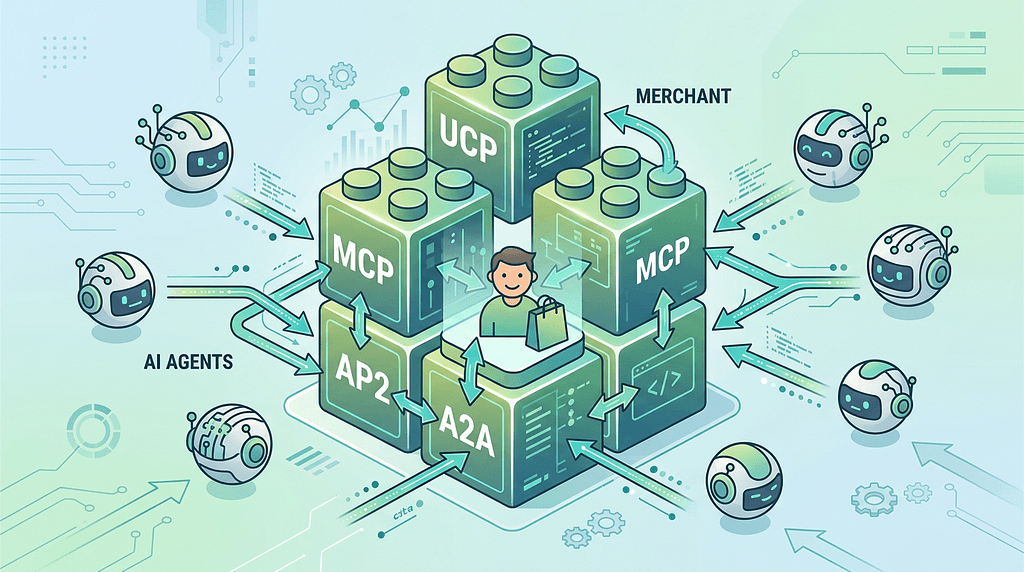
The four protocols that will quietly decide which Shopify merchants show up in the AI shopping era, in plain language.
Primary audience: Shopify merchants, non-technical founders, marketing leaders trying to brief engineers
Goal of this piece: Become the go-to non-technical explainer on the agentic-commerce protocol stack.
This is the second article in The Agentic Commerce Playbook for Shopify Merchants. The opening article argued that AI agents are a new checkout surface and that most merchants are invisible to them. This article zooms in on the plumbing that makes the surface work. There are four protocols involved, and their acronyms are everywhere: UCP, MCP, AP2, A2A. You do not need to implement any of them yourself, but you do need tooling that speaks all four. This piece is the plain-language version of what each one is, what it does, and what happens if any is missing.
The problem the protocols solve
When a human buys on your storefront, the whole interaction lives inside one system: the browser, the Shopify platform, and your payment processor. When an AI agent buys on behalf of a human, the interaction crosses three or four systems that do not share a database. The agent needs to discover what you sell, price it correctly, pay for it, and, increasingly, coordinate with other agents along the way. None of that is possible without standard protocols. UCP, MCP, AP2, and A2A are the four that matter right now. Each covers one of those steps.
UCP: the shared language for prices and promotions
The Universal Commerce Protocol, co-authored by Shopify and Google, is the structured vocabulary agents use to read a merchant's offerings. It defines how a product is described, how variants are expressed, how prices and promotions are formatted, and how shipping is declared. If the storefront is your shop's public face, UCP is your shop's machine face. It is the thing agents read before they recommend you.
What this means in practice: if your store produces a UCP feed that is rich and accurate, your products show up in agent-surfaced answers with the full picture. If your UCP feed is thin (for instance, missing the promotions field), your products appear with a subset of your real offer, which is often why another merchant beats you in the agent's recommendation.
MCP: How agents ask questions and get answers
The Model Context Protocol is a request-response standard. It lets an agent send a specific question to a system and receive a corresponding answer. In the context of Shopify apps, MCP is how an agent can ask 'what promotions apply to this cart?' and get a deterministic answer from the app that manages your discounts.
UCP is broadcast: a static-ish feed the agent reads. MCP is conversational: the agent pulls specific information from a specific source in real time. The two work together. UCP tells the agent your store exists and what you sell; MCP lets the agent interrogate details at the moment of decision.
For a merchant, MCP matters because it is the only way for live promotion logic to reach an agent. If your discount app does not expose an MCP endpoint, no agent will ever see the specifics of your live campaigns, no matter how good your UCP feed is.
AP2: money and authorization without handing over a card
The Agent Payments Protocol is how agents pay. It is a descendant of the decade of work on payment tokenization, extended to give an agent the ability to authorize a transaction on behalf of its user without the user handing over their payment method to the agent itself. AP2 covers authorization scope, amount limits, recurring authorization, and the audit trail required for disputes.
For the merchant, AP2 is mostly transparent because your payment processor handles it. What you care about is that your checkout supports agent-initiated AP2 payments. If it does not, the agent simply does not finalize with you. It finds another store whose checkout does.
A2A: agents talking to agents, so you don't repeat yourself
The Agent-to-Agent protocol is the most subtle of the four. It covers how agents delegate tasks among themselves. In practice, when a user tells a shopping agent Find me a birthday gift under $50 that ships by Friday', that agent may delegate the actual merchant query to a specialized sub-agent, which in turn may delegate shipping-time estimation to another. A2A is how those delegations stay coherent.
For a merchant, A2A matters when you are trying to understand why an order arrived with an unexpected attribution chain, or why your offer was shown alongside certain competitors. The coordination happens at this layer. You do not write A2A code. You ask your tooling whether it captures the trail.
What happens when one is missing
The four protocols are compound. Each has a distinct failure mode if it is missing or thin. A thin UCP feed means your store is present but underdescribed, so you lose on comparison. No MCP means your campaigns are invisible, so you lose on relevance. No AP2 means the agent cannot complete the purchase, so you lose the order entirely. No A2A awareness means you cannot explain your own attribution data, so you lose the ability to learn.
Most Shopify merchants have a reasonable UCP feed today because Shopify automatically generated it. A growing number have MCP exposure through discount apps that recently shipped it. AP2 support is nearly universal among mainstream payment processors. A2A awareness is the thinnest layer in the average tool stack, because it is the newest and requires attribution work that most apps have not yet done.
The three-minute checklist
You do not need to understand these protocols at a technical level. You do need to ask your tooling four questions.
- Is my UCP feed populated with live promotion data, not just static product data?
- Does my discount app expose an MCP endpoint that agents can query?
- Does my checkout support agent-initiated AP2 payment flows?
- Does my attribution layer capture the A2A trail, so I can see which agent chain originated each order?
If the answer to all four is yes, you are in a small minority today.
If the answer is no or 'I don't know', the next quarter of work is already outlined for you.
The rest of this series will go deeper into each of these. This piece is the map. Keep it handy.
Part 2 of 9, The Agentic Commerce Playbook for Shopify Merchants. Each article in the series stands on its own, but is designed to be read in sequence.
Key Angle
Most protocol explainers are either too technical (RFC-like) or too vague (buzzword soup). This piece picks exactly four protocols, explains what each does from a merchant's perspective, and shows the concrete failure mode if any of them are missing. The takeaway: a merchant doesn't need to implement any of these themselves, but they do need tooling that speaks all four.
Related on Discount Prime: Best Shopify discount apps · Free shipping