
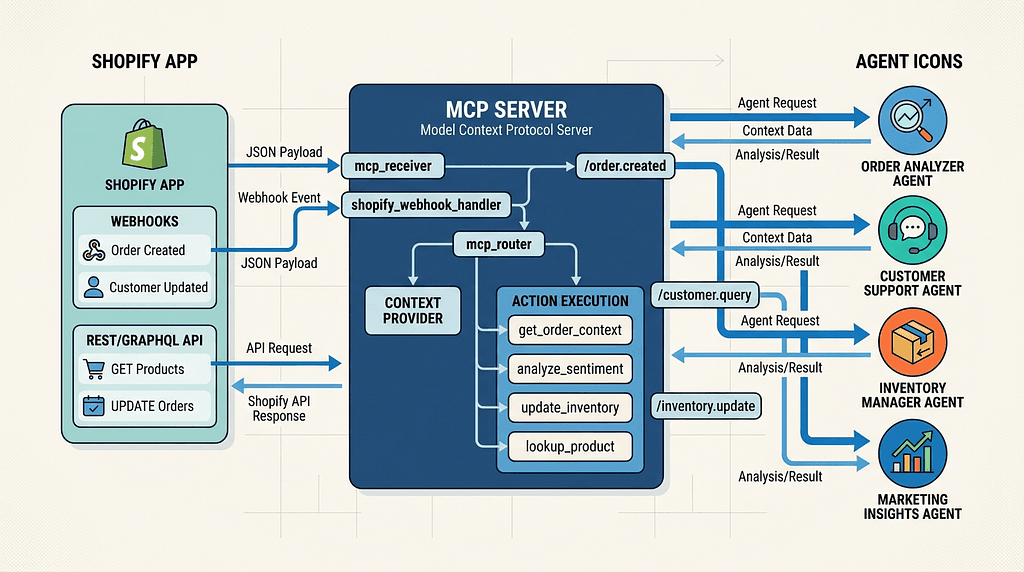
A hands-on walkthrough of exposing your Shopify app's logic to AI agents, with the design decisions that matter and the pitfalls that don't.
Primary audience: Engineers and technical founders building Shopify apps; anyone evaluating MCP adoption
Goal of this piece: Be the reference practical guide. Reader finishes with a working mental model and a concrete first endpoint to ship.
This is a companion piece to The Agentic Commerce Playbook for Shopify Merchants, written for engineers. Part 2 of the series explained what MCP is at the conceptual level. This piece covers the practical work of actually exposing a Shopify app via MCP: the first endpoint to ship, the design decisions that matter, and the handful of pitfalls worth calling out before they cost you time.
What does 'MCP server for a Shopify app' actually mean
An MCP server, in the context of a Shopify app, is a small service that exposes specific app capabilities through the Model Context Protocol so that AI agents can call them. It is not a rewrite of your app. It is a thin layer that translates agent-side requests into calls against your existing app's logic, with appropriate caching and response shaping. If your app already has an internal service layer, MCP is an adapter in front of it.
The server itself can run as a sidecar to your existing deployment, as a separate service, or, for smaller apps, inside the same process. The deployment shape matters less than the interface shape. What agents care about is the set of tools the server advertises, the parameters each tool accepts, and the response each tool returns.
The minimum viable first endpoint
The first endpoint to ship is intentionally unambitious: a read-only 'what promotions apply to this cart?' query. It takes a cart description (line items, customer context, channel) and returns a list of active campaigns that would fire for that cart, along with the resulting price impact.
This is the first endpoint for three reasons. It is deterministic: given the same input, it returns the same output, which is what agents reward. It is safe: read-only, with no side effects or risk of an agent accidentally running a campaign. And it is useful: it is the exact question an agent asks when reasoning about whether your offer is competitive on a given cart. Shipping this endpoint alone already places you in a small minority of discount apps as of mid-2026.
Auth and scopes: the two mistakes to avoid on day one
The first auth mistake is making the server accessible without meaningful authentication because' agents are public'. They are not. Agents act on behalf of users, and those users have merchant-specific scopes. Your MCP server needs to authenticate the agent as acting on behalf of a specific merchant, using the same access control you would enforce on any other API.
The second mistake is copying your existing API's scope structure into MCP without rethinking it. MCP has its own access patterns at the tool level. A tool that reads pricing data needs only price-read scope; a tool that modifies a campaign needs campaign-write scope. Do not grant a single broad scope for 'MCP access'. Agents will not need most of it, and the broader the scope, the less comfortable platforms will be surfacing your app to their users.
Caching and determinism: why agents punish flakiness
Agents call your server many more times than a human user would. For any non-trivial agent task, the same question is often asked multiple times, once during planning, again during verification, again at checkout. If your server returns different answers to the same input on different calls, the agent treats the server as unreliable and either caches itself or routes around you heavily.
The fix is explicit caching with clear invalidation. Cache responses by a hash of the request input, and invalidate by well-defined events (campaign created, cart changed, product updated). Agents are highly tolerant of caching headers; they use them. They are not tolerant of servers that look the same but behave differently. Determinism is not just a correctness concern for MCP; it is a trust signal.
From read-only to recommend-capable
The next step beyond the minimum viable endpoint is recommendation: instead of 'what applies to this cart?' the endpoint answers 'what is the best offer you can give this cart to maximize margin (or conversion, or AOV)?' This is the step where your app stops being a static reference and becomes an optimization layer that the agent actively queries during a decision.
The recommended endpoint is significantly more complex than the read endpoint, because it requires the app to reason about margin floors, stacking constraints, and optimization objectives. It is also where your app becomes genuinely differentiated. A read-only server is table stakes. A recommended server is a moat. Most apps will never ship the second endpoint. The ones that do will be the ones AI-era merchants select.
Three pitfalls not worth worrying about
Three things that get disproportionate attention in MCP discussions are not actually important in the first six months of shipping.
The first is protocol-version politics: MCP is evolving, but the core request-response pattern has been stable enough that early implementations port forward easily. Ship against the current spec; do not try to anticipate the next one.
The second is tooling choice. Python, Node, go: it does not matter for an MCP server. Use what your app already uses. The server is thin; the language choice has minimal long-term implications.
The third is perfect semantic alignment with every agent. You will ship and find that ChatGPT's agent, Google's agent, and Perplexity's agent each interpret your tools slightly differently. That is expected. Optimize for the most-traffic agent first, expand from there.
What shipping this buy you
A production-grade read-only MCP endpoint for a Shopify discount app can be built in four to six engineering weeks if you already have a clean internal service layer. The payoff is not immediate traffic; it is option value. When agent adoption crosses a threshold in your category (and it will, category by category), the apps with MCP exposure are the ones the agents find. The apps without it are not on the map. The work is worth doing early, while the cost is low and the positioning advantage is high.
Companion piece to The Agentic Commerce Playbook for Shopify Merchants. Standalone, but complements the adjacent main-series article.
Key Angle
Most MCP content is either protocol spec material or toy examples. This piece is written from the perspective of a Shopify app founder building a real read-plus-recommend endpoint. It covers the five design decisions that matter (auth, caching, determinism, rate limits, error surface) and skips the twenty that don't.
Related on Discount Prime: Profit analytics · Best Shopify discount apps