You can tell how a product matured by what it stopped being about. Ours stopped being about bigger discounts and started being about the profit underneath them.
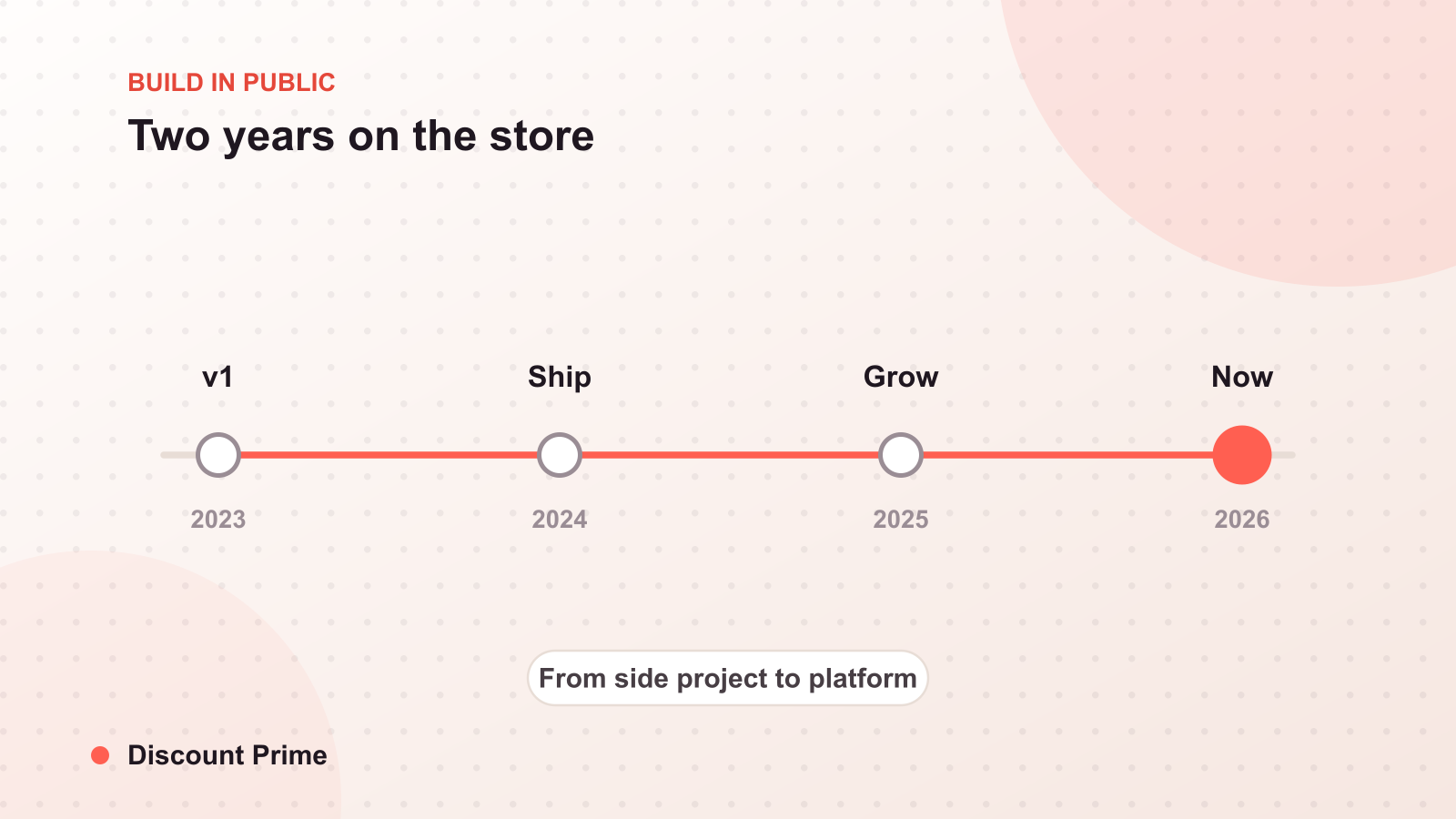
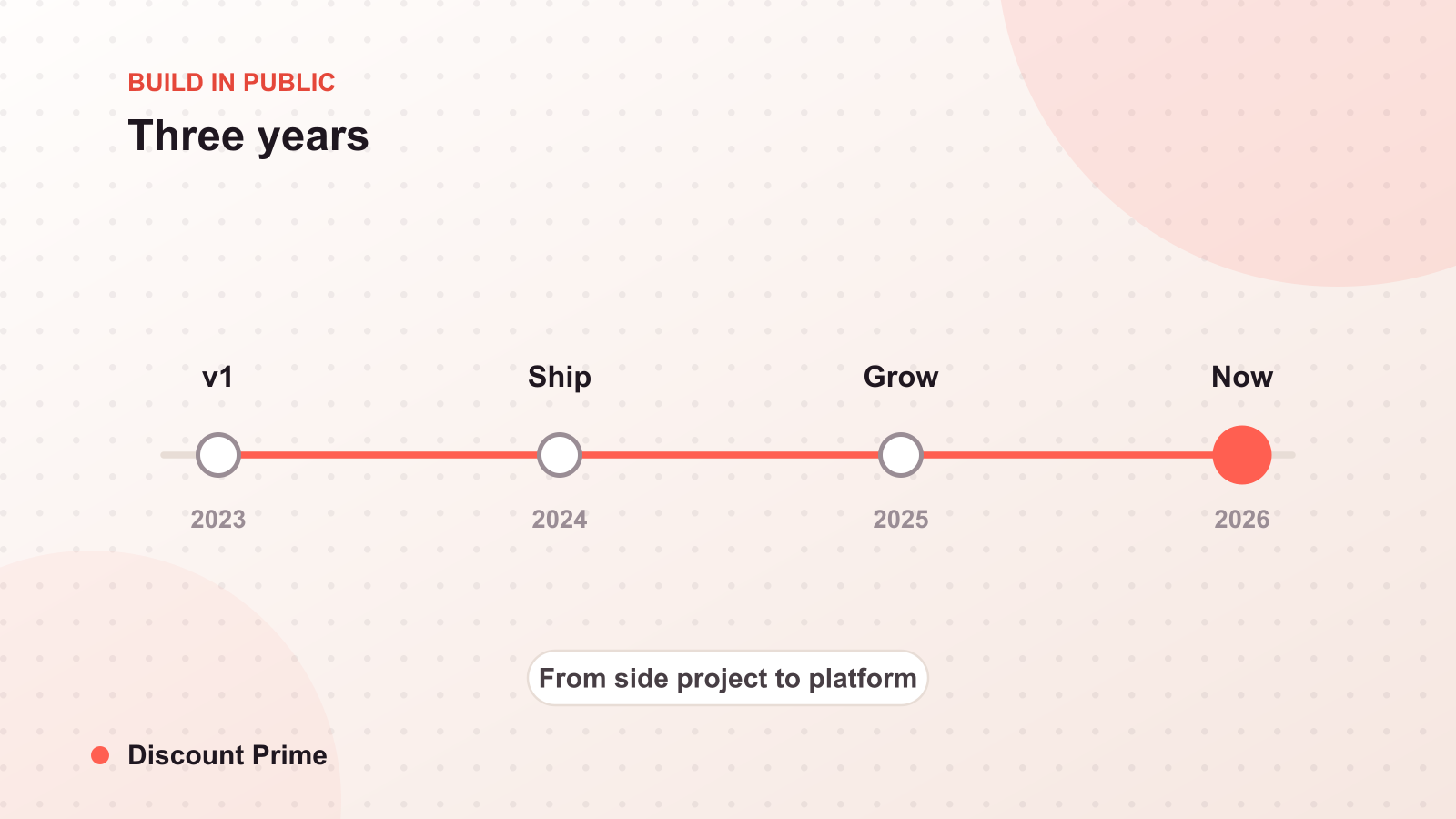
Three years ago this month, the first commit for Discount Prime landed. It was a side project with a narrow idea: let any Shopify store run real volume discounts without duplicate variants or Shopify Plus. Today it is a profit-first pricing platform that a lot of stores run their entire promotion strategy on. This post is the full timeline, the honest through line, and a note about what happens to this blog next.
Where it started: two features and one bet
The app went live on the Shopify App Store in October 2023, six weeks before that year's BFCM, which in hindsight was either brave or careless. It launched with exactly two things: volume discounts and quantity breaks. Buy more, pay less per unit, displayed on the product page, applied natively.
The bet that mattered was not a feature. It was the foundation. We built on Shopify Functions from the first commit, when many discount tools still ran on Scripts. Functions works on every plan and lives inside Shopify's own discount engine. That single decision is why the platform's transition years, right up to the Scripts shutdown announced this March, mostly happened to other apps and not to ours. We would make it again without hesitating.
The full feature timeline
Three years of shipping, in order:
- October 2023: volume discounts and quantity breaks. The launch. Buy-more-save-more pricing, no duplicate variants.
- December 2023: free shipping discounts with a progress bar. The first non-discount mechanic, and the first taste of nudging carts toward a threshold.
- February 2024: buy X get Y. BOGO and gift-with-purchase logic that does not confuse the customer at checkout.
- March 2024: tiered pricing. Structured price tiers customers could actually parse, built on the three-tier rule.
- May 2024: B2B and customer-specific pricing. Tag-based wholesale and VIP pricing without needing Shopify Plus. This one came straight out of support tickets.
- September 2024: discount analytics. The first time merchants could see which campaigns were doing anything at all. It should have shipped sooner.
- February 2025: profit analytics. The turn. Revenue reporting is table stakes; margin is the story. This is where the app stopped being a discount tool and started being a profit tool.
- March 2025: dropshipper margin-based pricing. Pricing rules that understand thin margins, for stores where a careless discount erases the whole spread.
- June 2025: dry-run simulation. Test a campaign against real order patterns before it goes live, instead of finding out in production.
- September 2025: profit floor. A hard stop that blocks orders which would sell below cost. The most opinionated feature we have shipped.
- January 2026: metafield-based targeting. Target products by what they are, not where they sit in a collection.
Read that list top to bottom and the shift is obvious. The first year answers "how do I discount?" The second and third answer "how do I discount without losing money?"
The through line: from discounting more to keeping margin
Year one gave merchants more ways to discount. That was the easy part, and honestly the crowded part. Plenty of apps help you cut a price.
Year two and three were about the harder and less glamorous question: did that discount actually make money? Analytics showed you the answer, profit analytics showed you the answer in margin terms, dry-run simulation let you see the answer before committing, and the profit floor refused to let the answer go negative. Each of those features exists because a discount is only as good as the profit it leaves behind, and most stores were flying blind on that number.
The uncomfortable lesson across three years is that the exciting features (new discount types) mattered less to our best merchants than the defensive ones (the tools that stop a promotion from quietly costing more than it earns). We built the flashy stuff first and the important stuff second. If we started over, we would invert that.
What three years taught us
Support is the roadmap. B2B pricing, the profit floor, dropshipper rules, all of them came from merchants describing the same workaround until we finally listened. The roadmap was never ours to invent. It was in the ticket queue the whole time.
Defaults beat toggles. Early versions exposed every option we could imagine. Merchants do not want fifteen switches. They want the app to have an opinion. Most of our best releases removed choices rather than adding them.
Margin is the only metric that survives contact with reality. Revenue flatters. A store can grow revenue and shrink profit at the same time, and a discount app that only reports revenue is helping it do exactly that. Everything we are proud of building points at margin.
What happens to this blog now
For a while, this archive has been catching up, telling the story of three years in order so it reads as one continuous line. That catch-up ends here. This is the last of the backfill.
Starting with the next post, later this month, the blog goes live and current. Same operator-to-operator voice, same profit-first lens, but written in the present tense about what is actually happening in Shopify discounting as it happens. If you have read this far, that is the archive worth following. You can browse everything, past and upcoming, at the blog.
To every merchant who installed in the early days, filed a bug at an unreasonable hour, or told us bluntly that a feature was confusing: the app is what it is because you did. See our profit analytics and volume discounts for where three years of that feedback landed, revisit the two-year roadmap-debt post for the middle of the story, and if you are arriving from a legacy tool, our Scripts migration map is where to start. Year four begins now.