
Shopify's merchant-side AI can now create discounts. Apps that try to beat it at that will lose. Apps that let you call them will win.
Primary audience: Founders of Shopify apps in the discount, bundle, pricing, and loyalty categories
Goal of this piece: Offer a clear strategic framework for a decision every app founder is quietly making. The reader walks away with a yes/no answer for their own product.
This is a companion piece to The Agentic Commerce Playbook for Shopify Merchants. The Winter 2026 edition of Shopify shipped Sidekick Pulse, a merchant-side AI assistant that can create coupons, segments, and campaigns via voice or text commands. For app founders in the discount and promotions category, Sidekick is the most direct competitive event of the year. This piece is about how to read it.
What Sidekick actually does in the discount workflow
Sidekick Pulse is not a competitor to a discount app in the traditional sense. It does not run its own discount engine. It sits above Shopify's native capabilities and orchestrates them with natural-language commands. A merchant tells Sidekick, 'run 15% off site-wide for the next 48 hours, but exclude the sale section,' and Sidekick creates the underlying discount objects using the platform's native tools.
That is powerful, and it handles a substantial share of the small-to-medium merchant's campaign workload. What it does not do (at least not in the current generation) is reason about margin floors, run profit-optimized stacking, manage cross-channel orchestration, or expose live campaigns to agentic product feeds. It covers the 'create a simple campaign' step well. It does not cover the 'make sure the campaign is actually a good idea' step.
The three places Sidekick stops
There are three structural limits on what Sidekick will do over the next two years, and understanding them is the central strategic question.
The first is data. Sidekick reasons over what Shopify knows natively. It does not know your supplier cost, your warehouse holding cost per SKU, your seasonal margin floors, or your category-specific return rates unless you have configured those somewhere accessible. Any decision that depends on that data is a decision Sidekick cannot fully make.
The second is optimization. Sidekick creates campaigns. It does not evaluate which of the five possible campaigns would lift the margin the most on your current inventory and customer mix. That is an optimization problem requiring merchant-specific models. The platform will not build those per-merchant. It is an app-layer responsibility.
The third is interoperability. Sidekick orchestrates Shopify-native features. It does not orchestrate the agentic feed, the MCP endpoint, the cross-channel coherence that a serious merchant now needs. The scope of what an agent-ready promotion requires is wider than Sidekick's territory.
The MCP tool pattern as a cooperative strategy
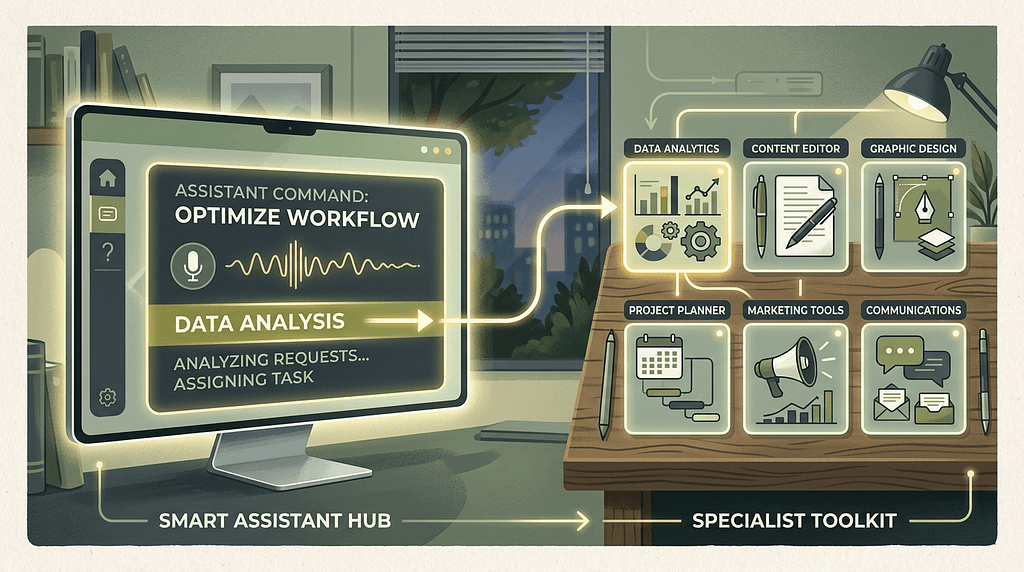
The single strategic move that changes the math for a discount app is to expose itself as an MCP tool that Sidekick can call. When Sidekick encounters a merchant request that exceeds its own capability (for example, 'create a campaign that maximizes margin, respects the stacking rules, and exposes offers to AI agents'), it can delegate to an app if that app has published itself as callable.
This is the same pattern that has played out in every dominant-platform-with-assistant combination for the last twenty years. Apps that let the assistant call them become more valuable as the assistant grows. Apps that try to replace the assistant lose distribution and spend their time rebuilding what the platform ships for free. The second path looks brave and is losing by default.
Why 'compete directly' is the worst move for small teams.
There is a temptation for an app founder watching Sidekick eat into their top-of-funnel to respond by building a better general-purpose AI assistant inside the app. It sounds coherent. AI is where value is accruing, so build AI. In practice, for a small team, this is a commitment to losing. Shopify has more data, deeper integration, broader distribution, and a faster retail-to-AI loop than any third-party app is likely to match. Building a general-purpose merchant assistant against Sidekick is a losing game for nearly everyone who tries it.
The winning game is to be the specialist Sidekick calls. That means depth in one territory (profit-aware discount optimization, cross-channel promotion orchestration, margin-protected stacking) and exposure in the interfaces the platform assistant uses. A focused specialist that Sidekick reaches for is more durable than a general assistant competing for the same screen.
How to position your app in six months
The concrete work is narrower than the strategic framing suggests. A discount or promotions app that wants to be in the cooperative position in six months needs three things:
- an MCP endpoint with the app's core capabilities exposed in a form an assistant can call;
- a registration pattern so that Sidekick knows the app is available; and documentation positioned for LLM discovery, not just human readers.
The engineering effort is real but bounded. The strategic effort (letting go of the ambition to 'be the AI' and settling into 'be the tool the AI uses') is the harder part.
The apps that make this shift early will compound as Sidekick adoption grows. The apps that spend the next year fighting Sidekick head-on will discover the ground moved beneath them faster than they expected. Cooperate or compete is not a rhetorical question. It is a category-defining call that every founder in this space is making, whether consciously or not.
Companion piece to The Agentic Commerce Playbook for Shopify Merchants. Standalone, but complements the adjacent main-series article.
Key Angle
The instinct when a platform ships a competing feature is to fight or flee. This piece argues that the better move for discount apps is neither. It's to become the execution layer Sidekick calls. Apps that expose themselves as MCP tools become more valuable as Sidekick adoption grows. Apps that try to replace Sidekick become a smaller, slower version of it.
Related on Discount Prime: Best Shopify discount apps · Profit analytics