
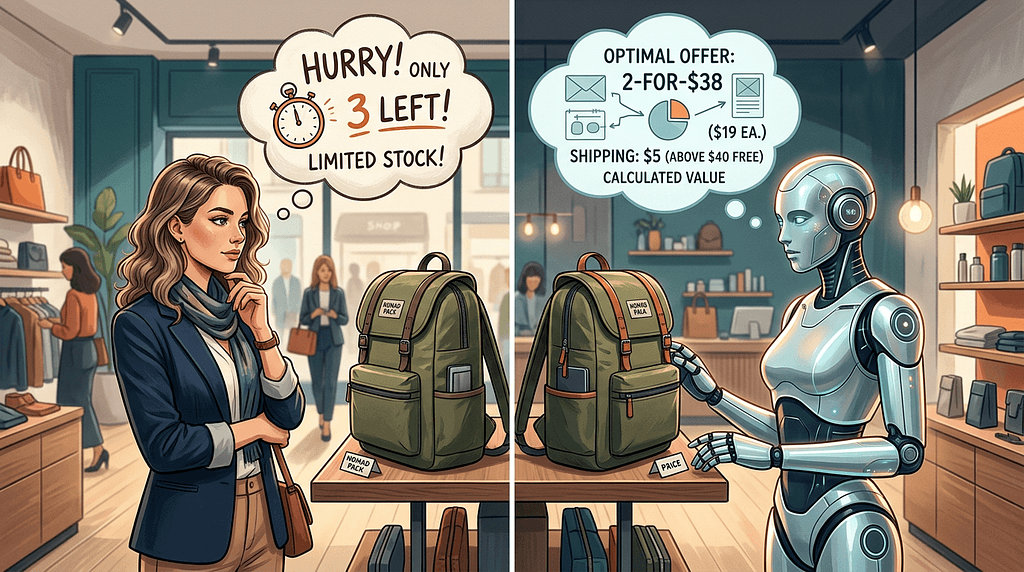
The pricing psychology that works on humans does not always work on agents. The ones that do are different, specific, and underused.
Primary audience: Shopify merchants experimenting with AI channels, pricing strategists, revenue ops leaders
Goal of this piece: Introduce agent-specific promotion framings as a distinct discipline. Merchant finishes by being able to articulate at least two promotion types that work better for agents than for humans.
This is the third article in The Agentic Commerce Playbook for Shopify Merchants. The first two articles argued that your promotions are invisible to agents and explained the protocols that enable agent-channel commerce. This one goes a layer deeper. Assume the plumbing is in place. Assume your campaigns are reaching agents.
What should the campaigns themselves look like?
The answer is that the promotion mechanics you have used on humans for the last decade were shaped by human attention. Agents are not human-attention machines. They are patient query executors that parse structured information and optimize against a user's stated goal. A promotion designed for one audience fails on the other (not dramatically, just quietly) by producing lower conversion for reasons that are never obvious from a dashboard.
Why agents don't respond to urgency the way humans do
Countdown timers, stock-running-low banners, and flash-sale framings evolved to interrupt a distracted human's drift toward abandonment. They work because a human is weighing the offer against the cognitive cost of continuing to think. An artificial scarcity cue tips that weighing. Agents do not weigh cognitive cost. They evaluate the offer against explicit criteria that the user provided. A countdown is noise. A scarcity banner is noise. A one-day window is either relevant or irrelevant; the agent does not find it more compelling because the timer is moving.
This is not a criticism of urgency mechanics. On human traffic, they still work. It is a warning that applying them to agent traffic adds nothing and may actively harm your feed's signal-to-noise. Some agents explicitly downrank offers that rely heavily on urgency, because urgency is a heuristic humans use to detect manipulative merchandising.
The four promotion types that translate cleanly to agents
Four promotion structures work well in the agent channel because they are parseable and deterministic.
The first is structured quantity pricing. '2-for-$38' is an offer an agent can evaluate precisely: for a user asking 'find me two of this', the agent can compute that the structured offer beats buying two individually. Tiered quantity discounts in general (for example, 'buy 3 get 20% off the third') work for the same reason.
The second is threshold-based shipping. 'Free shipping over $40' is a deterministic condition that an agent can include in its total-cost calculation. It performs well in agent channels because it changes the cart's numeric outcome in a way the agent can verify.
The third is bundle pricing. A pre-defined bundle at a specific price is a single item from the agent's perspective. The agent is not choosing three products; it is choosing one bundle. If the bundle price beats the sum of the components by a defensible margin, it wins on the comparison.
The fourth is condition-scoped discounts that the agent can evaluate without having to guess. 'First-time customer: 10% off' is such a case: the agent either knows or can be told whether the user is a first-time customer. The clearer the condition, the better the agent can reason over it.
The three that don't, and why pushing them harder backfires
Three promotion types translate poorly. BOGO in its classic form is one. 'Buy one get one' is ambiguous to an agent unless the structure is explicit about which item is discounted, at what percentage, and under what condition. A well-structured BOGO is fine; the loose marketing framing is not.
Gift-with-purchase is another. A gift has unclear value to an agent's cost calculation. The agent does not know how much the user values the gift, and the user has typically not specified a preference. Most agents conservatively ignore gift-with-purchase as a meaningful variable.
Flash sales framed around urgency are the third. The discount itself is fine; it is the framing that fails to carry into the agent context. The underlying offer should still be structured and exposed; the 'for the next four hours' copy will not move the needle.
The translation layer: same campaign, two framings
None of this implies you should redesign your human-channel promotions. The pattern that works is a translation layer. The campaign is defined once, in the merchant's operational terms, and the presentation differs by channel. A '48-hour flash sale at 20% off' on the storefront becomes '20% off site-wide through June 5' in the agent feed: same offer, different framing appropriate to the audience.
The tooling to do this is not widely available. Most discount apps publish a single representation of a campaign and rely on the storefront or the agent to figure out what to do with it. The apps that will matter in the next phase are those that automatically generate channel-specific representations, so merchants do not need to split their campaigns into two sets manually.
A simple test to run on your next flash sale
If you want to see this dynamic directly, run the following experiment on your next promotional campaign. Create two feed representations of the same underlying offer.
- In one, include the urgency framing, the flash-sale copy, the scarcity cues: the full human-channel presentation.
- In the other, strip all of that and leave only the structured numeric claim.
Serve each to a subset of agent queries over a one-week window. Compare the conversion of the agent-originated orders for each.
What most merchants find when they run this is that the structured version converts meaningfully better in the agent channel, often by 10 to 25 percent on a clean test. The difference compounds over months, because it is not noise; it is a consistent effect driven by the agent's information diet. The merchants who understand this early will have a measurable advantage by the end of 2026.
Part 3 of 9, The Agentic Commerce Playbook for Shopify Merchants. Each article in the series stands on its own, but is designed to be read in sequence.
Related on Discount Prime: Buy X Get Y · Profit analytics